Running ultra marathons and trail runs wherever I can. Finisher of the Northern Travers, Winter Spine Challenger South and numerous other 100 mile races.
This link is the the Apple podcast for the Ginger Runner Live podcast with David Roche. It’s a fab insight into the methods he believes are the best ways to train. Great advice from a legend of Ultra Running. Well worth a listen
Tuesday – Fast finish – which means you progressively increase pace from each to moderate pace during the session. This session ended with a period at Heart Rate Zone 3 – medium effort – for 12 minutes.
Wednesday – Easy effort
Thursday – Easy to moderate effort
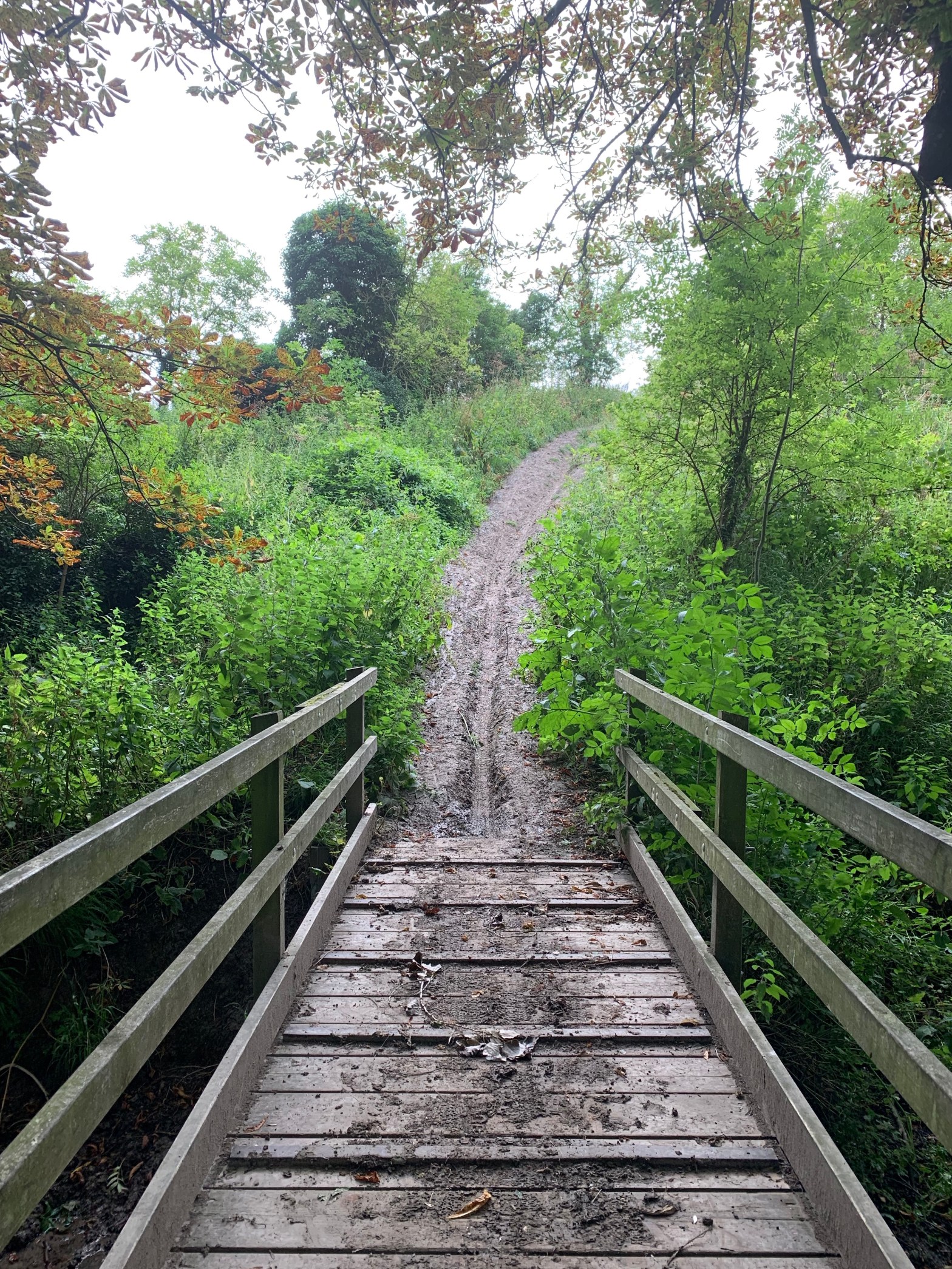
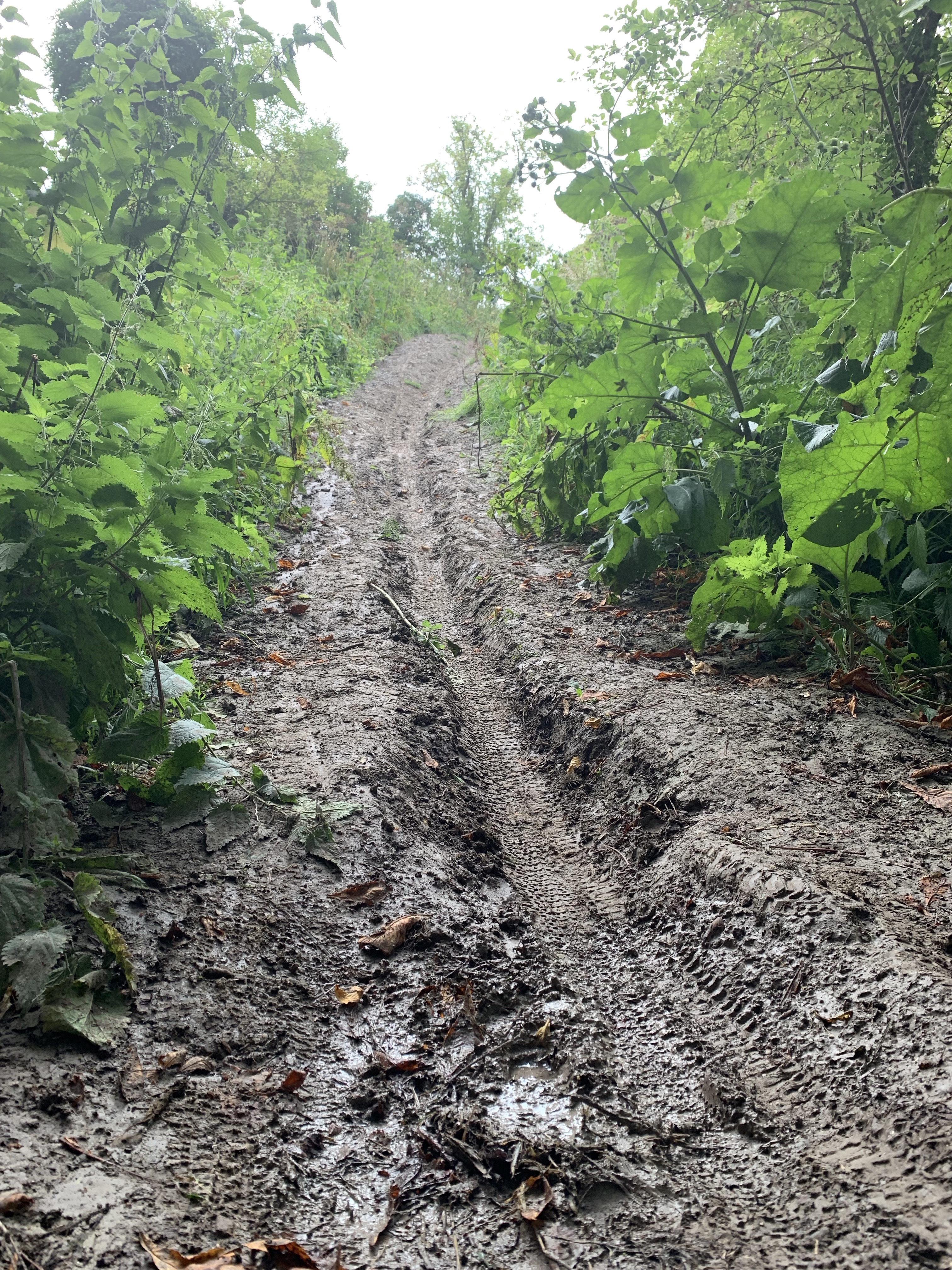
Friday – Hills. – 8 reps of 1min uphill at pace, 2 minutes low effort cool down.
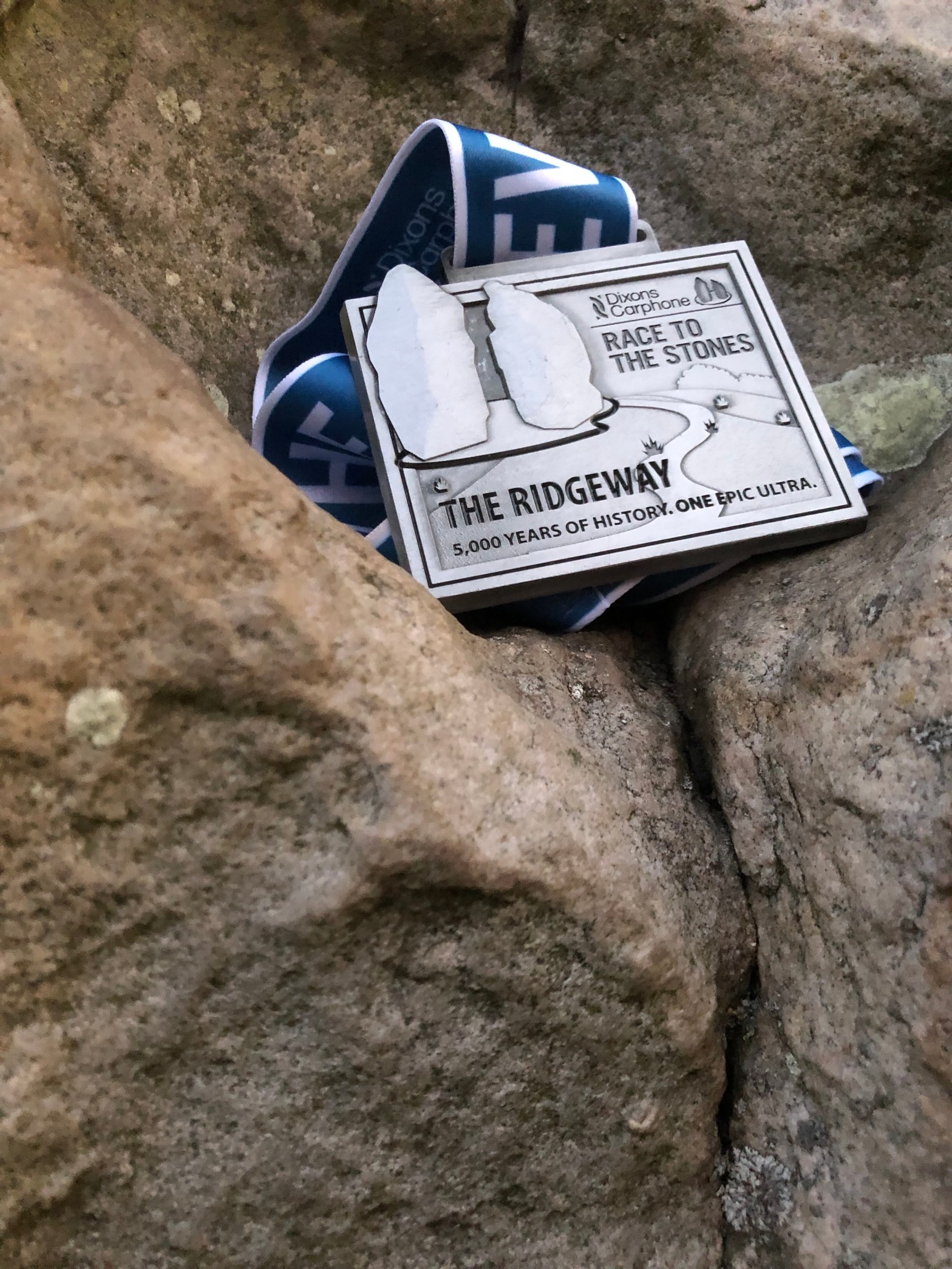
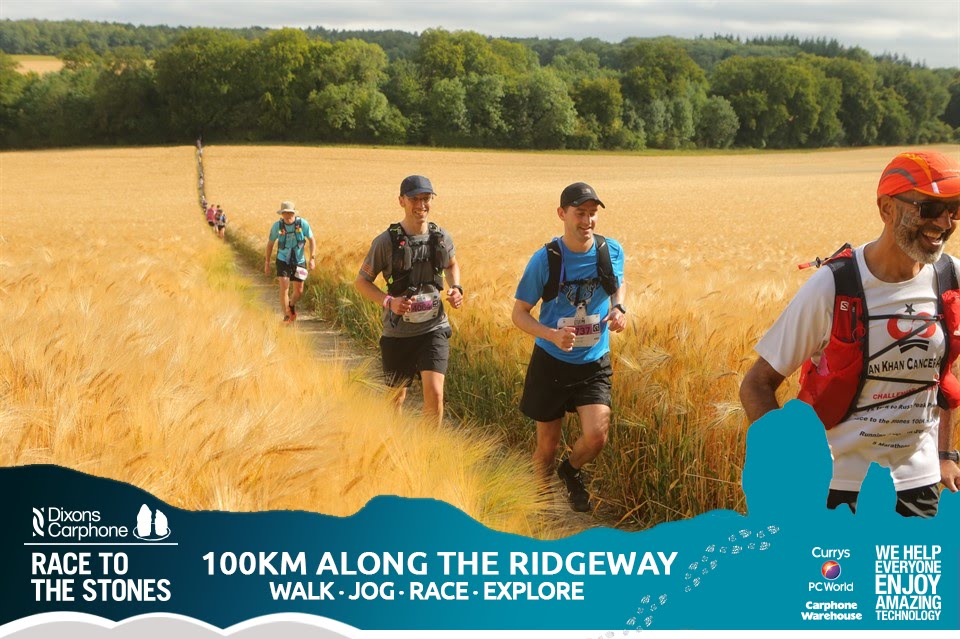
Having written a review of the Race to the Stones 2019 (LINK), I have now reflected more on what I did on the day and in the lead up to the race. The race was great and I really enjoyed it. The experience. was unbelievable and one I know I will repeat. In fact I have already booked my next ultra.
I recorded a video of my day as well which you can access below:
I then turned my mind back to the many months ago when the crazed idea of running an Ultra had leapt into my mind. At the time I had only run a Half Marathon, no further. My first marathon was booked, but would only be 3 months prior to the Ultra, so I had to get my self together for a race of immense scale, with little experience both physically and mentally. There was little that explained the urge to sign up, and there was even less in my head about how I was going to achieve what was needed to get to the start line. And when I get to the start line, what will I need to take? How will I strategise my refuelling? How will I feel? What will my body do?
When I set out on the journey I had no clue. I researched a bit, read a few books, surfed the internet and yes, there are loads of things out there. But everyone is different and knowing what parts of everyones experiences would relate to you was difficult. But what I did realise was that the more you read and look into it the more you realise that fact, that there is no text book to follow and listening, seeing, reading or understanding others ways of tackling this challenge helped me to get to that start line, believing I would be able to reach the finish line!
So you’ve read this far, I guess you want to know if it’s worth continuing. Well I hope you determine that its worth another minute or two, before you google stealth cats on youtube.
This is the summary of my experience.
Training
I decided that i would really try to train specifically for the ultra from the new year, 6 months of training. I also decided from research a few things:
An ultra isn’t about pace and speed (not for me anyway) so lots of speed sessions are less important in your training sessions
Long runs are key
Tired runs are important to understand how your body responds to running when it feels tired and worn out.
Ultimately the greater amount of distance you can build up in training then this will be a good base for an Ultra of 100Km
I had read about 80/20 running whereby you manage a lot of your sessions at an easy pace (about 80% of session time at an ‘easy’ pace). The remaining time (20%) you spend putting higher efforts in (intervals, fartleks etc). I liked the structure of this and how it gave each session a purpose. The book by Matt Fitzgerald (link. here) gives some structured training programs but only up to Marathon distance. I decided that I would follow this plan (actually level 2 for marathon distance) but for the long runs I would focus purely on long distance, ideally looking to build up to 50/60Km before race day.
I managed to achieve the training program, and 2 weeks before RTTS I managed a 52Km trail run – which was a really excellent preparation for the day. (Strava link)
Kit
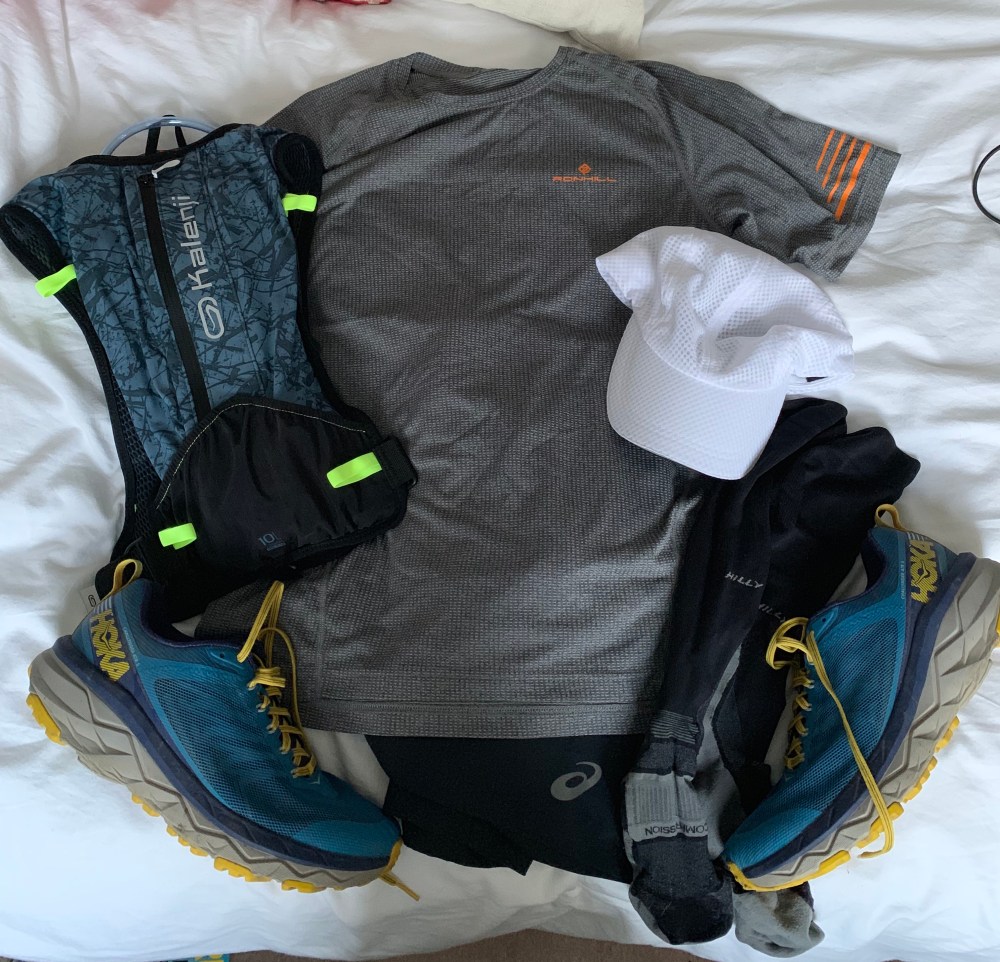
The kit I wore to start was nothing special. I researched the weather and knew it wasn’t going to be cold, so dressed for a fair weather run. I also researched terrain. I run the Ridgeway routinely and had read some experiences people had written about RTTS previously and it was clear that unless the weather was significantly wet, the terrain is likely to be firm. Road shoes seemed a good plan – so I went with Brooks Levitate 2.
Running Bag
I used the Kalenji 10L trail bag. from. Decathlon. Its. a. great price and genuinely I’ve found it to be incredibly comfortable, good fitting and adjustable, with loads of storgage.
I packed a change of socks and a change of shirt, as well as a spare cap. – I always run with a cap.
Feet
This was my big concern. if I suffered blisters early on I could really suffer and that would then cause me problems for some time post race. I played around with a few strategies prior to race day, and viewed a few YouTube videos. I settled on using Zinc Oxide tape to tape the instep of both feet and wrap my big toes. nothing else was taped. I also put powder into my socks – Baby Talc – to keep my feet dry and provide a little more friction protection.
Walking Poles
I never intended to use these, and actually don’t own a pair. But having completed the race I would say for a runner it isn’t worth the effort of carrying them for the few times they might be helpful. But if its technique you really get comfort from, then poles for RTTS might suit you.
Other items in my pack
I packed some extra nutrition (see later), battery chargers for phones etc, head torch, first aid kit.
Nutrition
This is where I felt under prepared. firstly I wanted to run the race as much as I could. so I knew that I wasn’t going to go eat massive lunches of hot food. I thought I might grab a sandwich or something similar, but was really unsure of what to expect. Having not run such a length of race or time out, I didn’t know what my body would be asking for, what I would want and what I felt I might be able to manage.
I took water (1L) with SIS hydration tablets (500mL) and Tailwind (500mL). I took some additional tablets (SIS) and sachets (Tailwind) to use in refilling stations, so that I could be sure to get the salts and also the extra carbs/calories that Tailwind provides. I trained using both of these throughout the 6 months prior to the race. I didn’t;t want to rely on the High5 hydration tablets etc being stocked along the course in case they didn’t;t work for me or even upset me.
I took some flapjacks from Chia Charge which I adore and find easy to eat when on the move. Again, trained with these prior to racing.
The final two items I took were SaltStick fast chews and Dextrose tablets. Both of these I felt would help though I had limited training experience with them. In Brighton Marathon 3 months prior to the RTTS I suffered cramp towards the end of the race and I felt some additional Salt options would help, so SaltSticks seemed a wise plan. The dextrose tablets were there in case I felt a sugar low.
During the race
So during the race my strategy was:
change socks and shirt around halfway
stop at each aid station to manage pace and refresh
drink minimum 500mL between each stop
eat flapjacks maybe 1 per 2 aid stations
eat sensibly from the stocks at the stations
saltstick tablet every 2 stations
That was the plan and most of it worked that way.
I found that making myself consume the fluids I was carrying to have at least one fully empty flask at each aid station really worked, and during the day I really never felt dehydrated at all, even though it was a pretty warm run in the end.
I stopped at all but pitstop 1, I felt good so carried on – meaning I ran about 25Km before my first stop. I was out of liquid by that time, but that was the only time I was in real need of refuelling my stock.
As far as food was concerned, I found my body didn’t want it. I was consuming calories via tailwind and I ate over the course of the race 2 flapjacks. I did consume fruit: bananas, oranges and pineapple, but precious little else until Pit Stop 9 at 88Km. There I found malt loaf and immediately ate 3 small lunchbox sized packs ! I love malt loaf so …
I was concerned as to whether this would be enough, and on reflection I am surprised it was, but I felt good with it, I never felt weak – I felt worn out from running – but not week in a bad way.
Running Strategy
Though I planned to run as much as I could – and I pretty much did, I knew I had to pace things. I intended to walk most hills that would be a running struggle. little inclines OK to run, but larger hills I would walk. As a strategy this sounded common, but. a lot of people seemed to continue run the walking hills. Though they moved past me on the hill, I felt I routinely caught and overtook them after the hill levelled out. I was certainly trying to power walk the hills, but I still felt that as a strategy I saw too many people try and slow run the hills and clearly this was taking a lot out of them. I think the walk the hills was a good strategy, The challenge is to ensure you pick the right ones to run on. I missed a few I should have run, but there’s always next time!
Pace wise I was hoping to run 6min/km. This would then be reduced as an overall pace by the hill walk sections and pit stops. I generally run much faster but knew that this wasn’t the race to try and be speedy and break into fastest Km splits. I wasn’t;t far from this I think so was pretty pleased afterwards.
Psychology
I expected periods whereby my head started to tell the heart that the body was struggling and that maybe I was trying too much too soon. I got through to 50Km before this set in a bit. I didn’t;t really have a strategy to deal with it, but two things helped me, no make that three.
Firstly I kept picturing the moment of finishing the race, having my wife there to see me over the line and that sense of achievement that I would feel. To be honest I felt quite emotional when thinking this and on a couple of occasions had a bit of a tear in my eye moment.
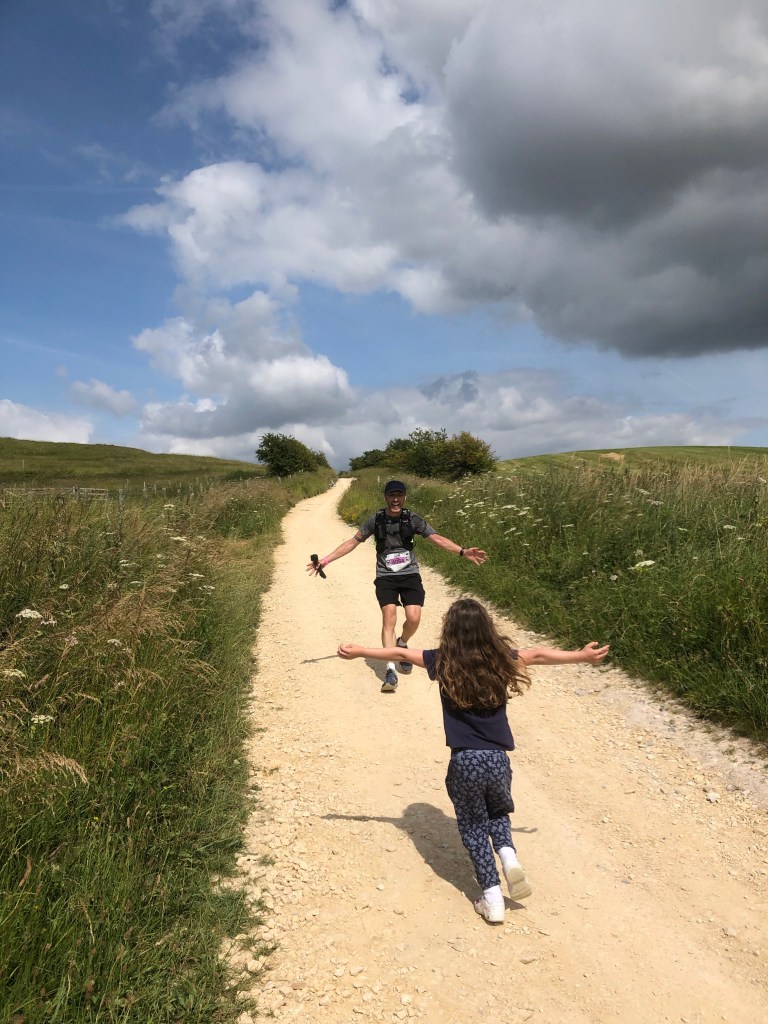
Secondly I organised for my youngest children and wife to meet me around the 40 mile mark. Near the National Trust site of Uffington White Horse Hill. A place we knew well. This was a massive lift. Seeing them and having a brief run with my 5 year old was just one of the best experiences ever. It was only a short pause but the impact on my motivation and feeling that I would succeed was huge.
The final thing was something that I wasn’t expecting. I’m a lone runner normally, Always run on my own with the exception of organised events. However, at RTTS I fond a number of times I would chat with people and discuss the race and previous experiences. Amazingly I also met somebody I knew but hadn’t spoken to for over 10 years! Odd things happen when you run 100Km !!
The Recovery
Having completed the race the recovery was the next unknown. I had done 2 marathons by the time I reached the start of RTTS and for both I suffered with aching thighs, aching calfs and hated stairs for the first 48 hours post race. Legs were back to normal within 5 days.
For an Ultra I didn’t;t know what to expect but my strategy was this:
Keep moving – the day after the race I did some shopping, looked after the youngest children for a while and continued moving around. Stairs were an awkward inconvenience but manageable.
Refuel – I ate sensibly, not excessive, but good healthy ‘normal’ food.
I used ‘Aftermath‘ recovery shake from Bulk Powders which I really feel speeds up recovery
I continued to use rehydration tablets in water once a day for the first 48 hours.
I was back out running after 2 rest days. – 5Km
Stretching on ret days after a race also helps and ensures you muscles get the best opportunity to recover quickly and healthily
Lessons Learnt
I was happy with how the race went. It exceeded my expectations, and I felt I coped well.
I would say these are the key things I would look to improve next time:
More hill training – being stronger on hills would be great, but generally hill training helps build strength and stamina so is a good help in endurance running
I would look to eat more – I didn’t suffer but. I was worried after the race that I consumed. very little on race day and in another circumstance I might have struggled a. lot more
Tape feet more – my feet were in a really good state after the race but I got a few small blisters (3 I think) between my middle or little toes. I hadn’t taped these. So I would tape theses. I would. also consider. Injinji socks which are the glove like socks. I’ve bought some of these now to try!
Such myself more. I felt afterwards that I could have pushed a bit more, I learnt. what my body can do and what my mind will do in retaliation, and in reflection I. think I. could have pushed more in some stages. without. it being detrimental to the overall race or my wellbeing.
Don’t underestimate. the value of fresh top and socks, and the benefit of talking to others and engaging with other. runners – even if you are their on your own! you will find this all a boost.
I want to do it again …
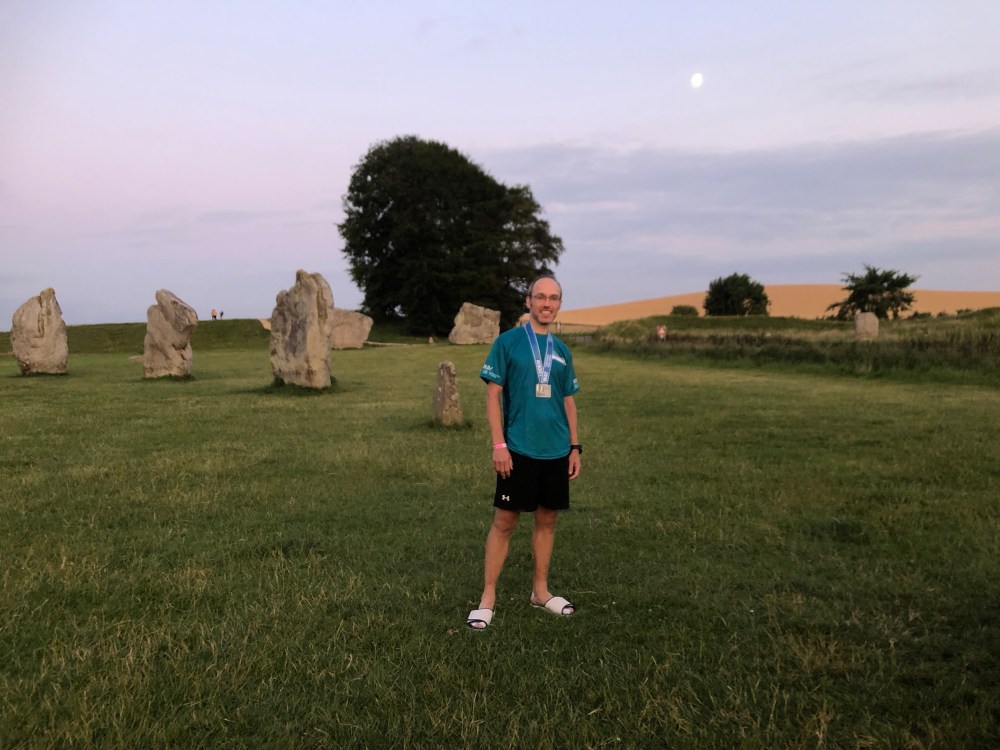
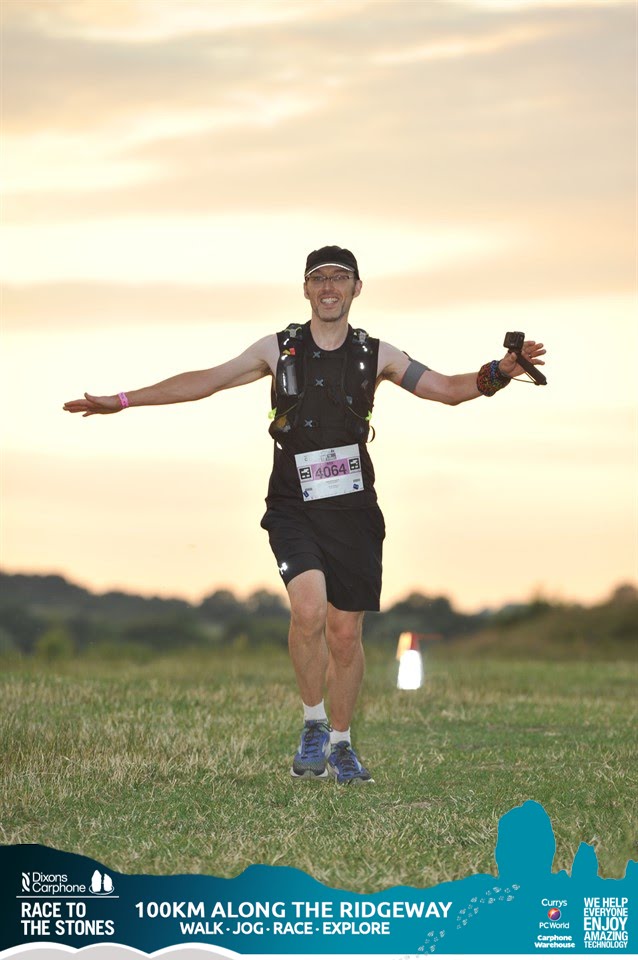
So that’s my story of what I did to complete RTTS 100Km in 13 Hours. I don’t think its spectacular, but. I am very proud of this as a first 100Km race. I am absolutely going back out there as well. I have already booked Race to the Tower 2020 and have my eye on a 100Km+ one day ultra as well which I will organise very shortly for early 2020.
Im absolutely bitten with the Ultra bug. They are the most amazing experience I can imagine in running and I know that I am meant to be out there running endurance races. Yes I;ll take it easy and ensure I stay safe, but there’s more miles in these legs yet.
Thanks for reading, and if you want to know anything else about my experience or what I learnt on the day feel free to message me via my facebook page ‘ridgeway runner’, or use my email nick@ridgewayrunner.com.
Having now introduced hills into my training plan I thought I would share this. It’s a good little article explaining why hills are helpful, but also some basic tips on how to run hills.
So, being a glasses wearer with a pretty chunky prescription I have struggled finding sunglasses that work for me or glasses that work in the rain. I’ve seen plenty of people give reviews on sunglasses with prescription inserts – never very positively and I have tried but simply can’t get on with contacts. Yes laser might work, but I’m not yet there on that idea. So I keep on the lookout for sunglasses.
A few ranges of glasses and a massive set of finish combinations. Single colour or mixed colour frames and a willingness to combine sides and frames how you want.
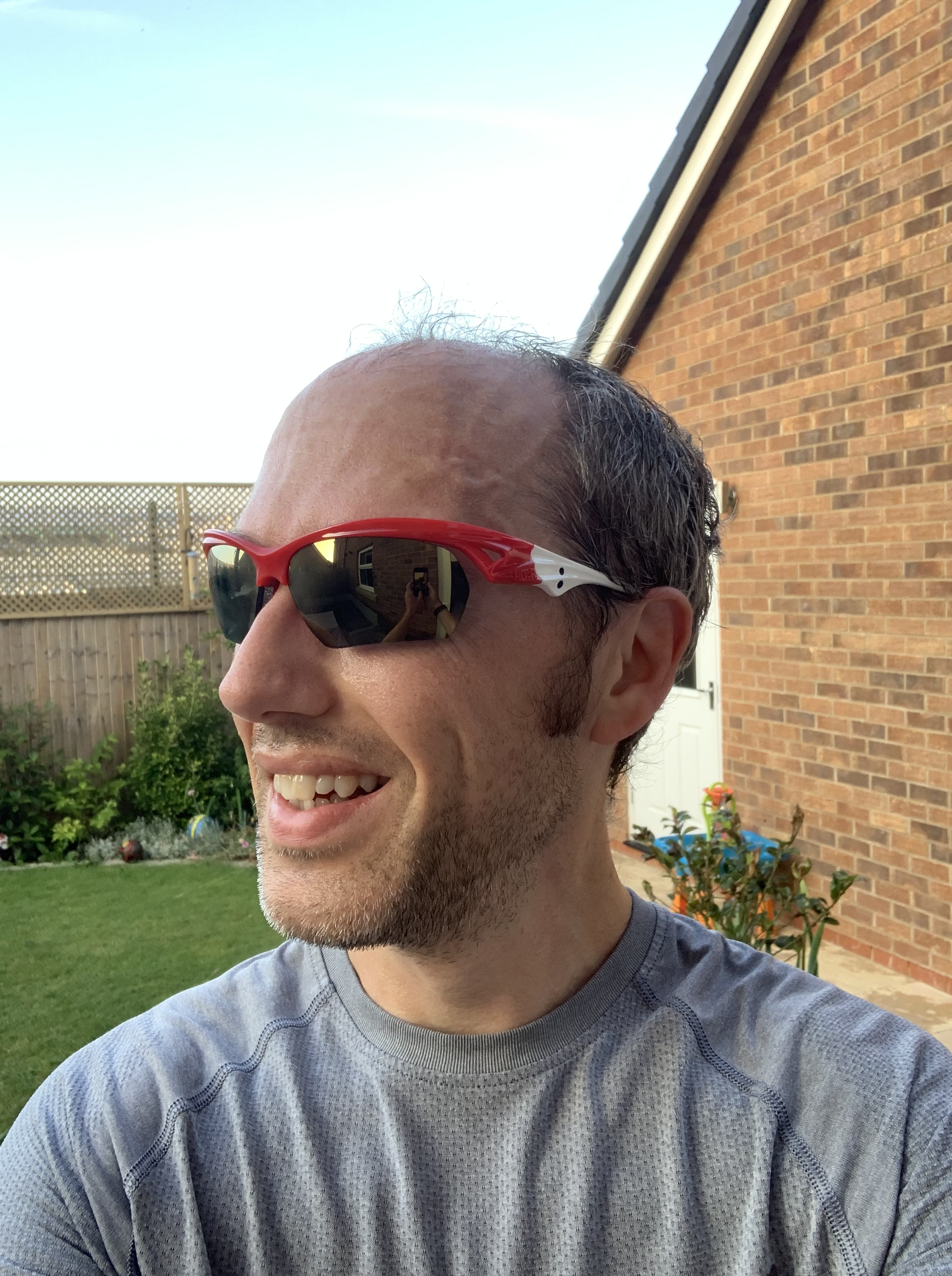
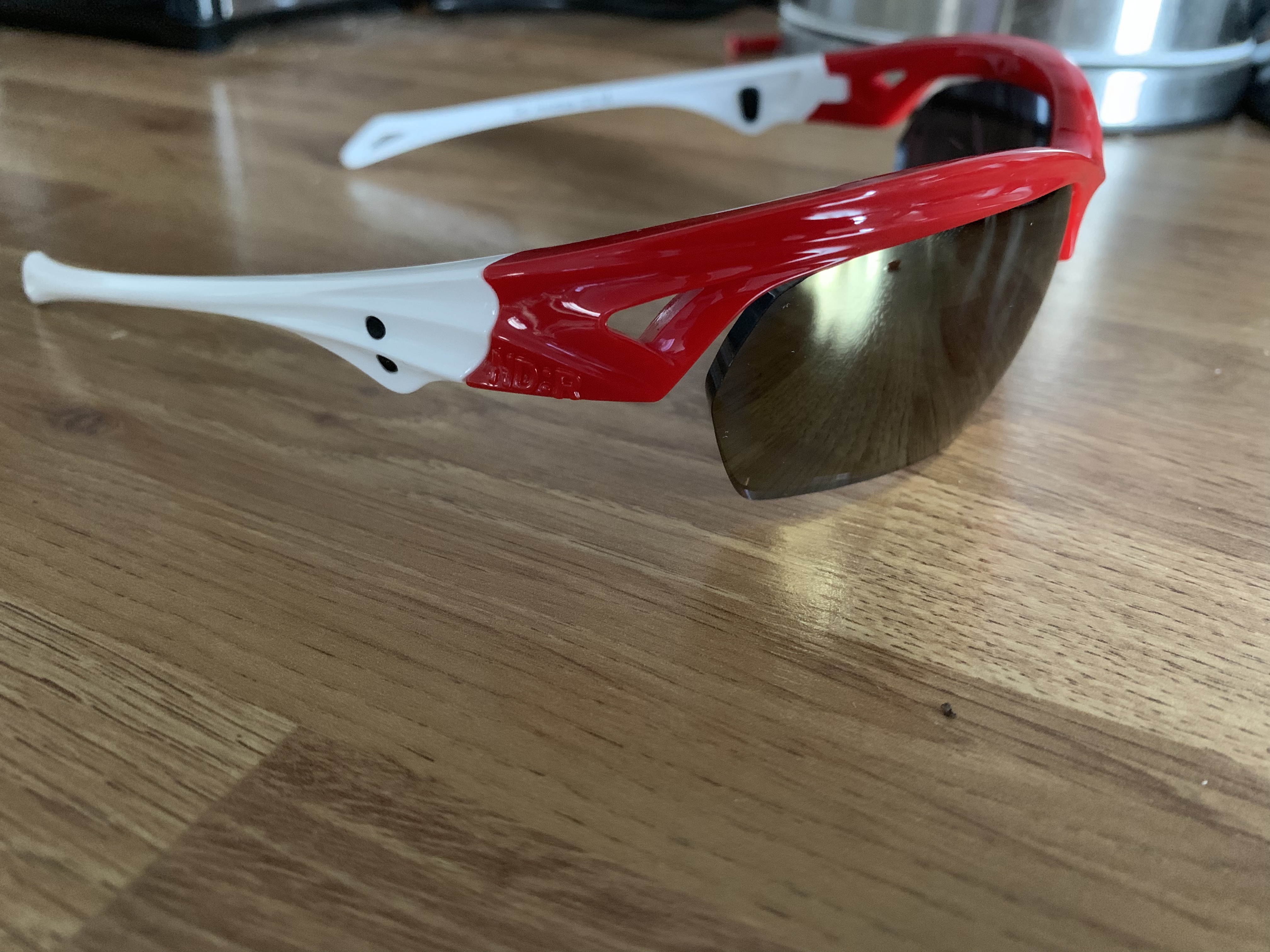
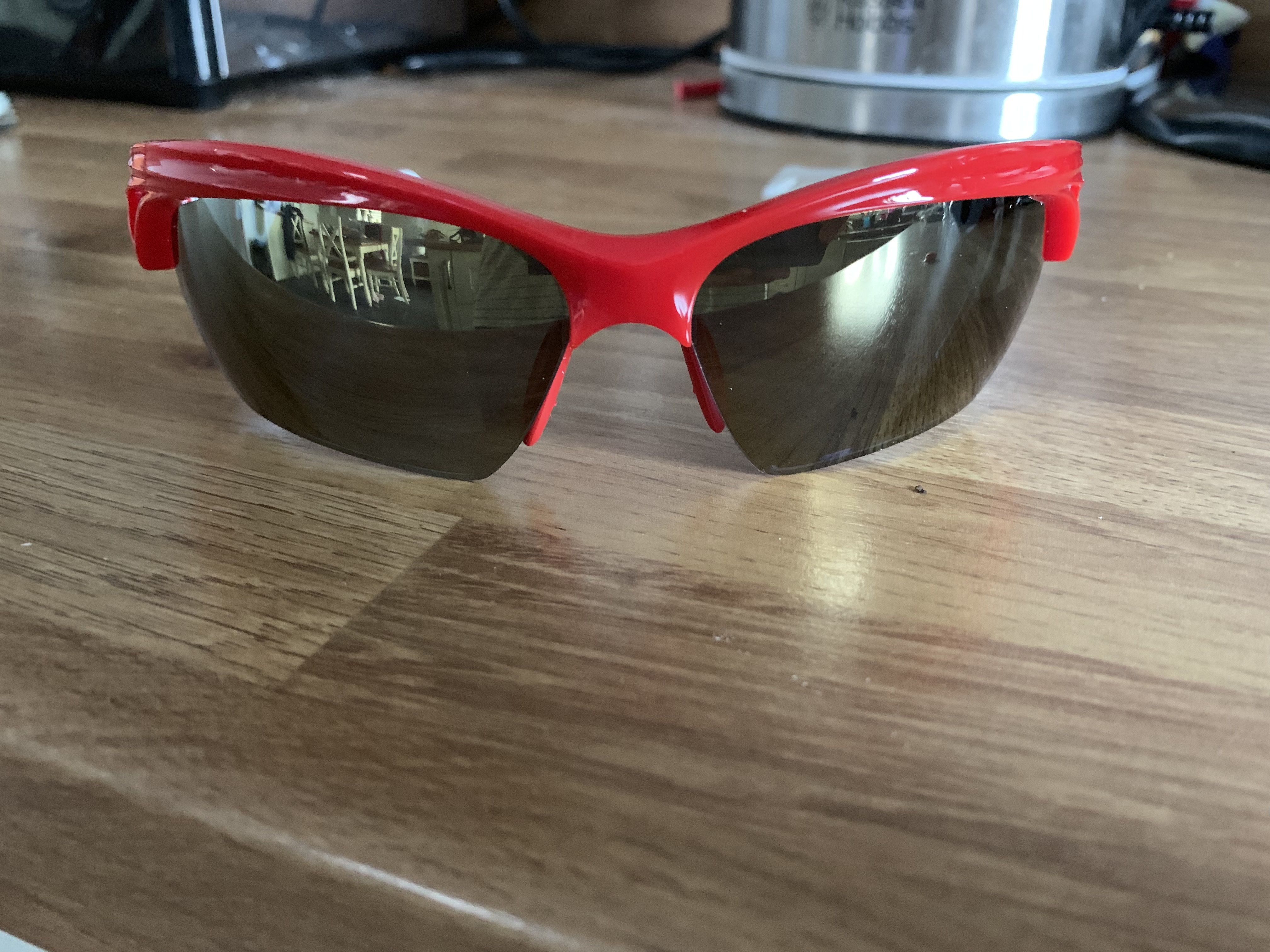
I opted for red frame and white fronts.
Lenses are varied with different tints, material, polarised or not, mirror or not … the choice is huge.
I wasn’t sure on the finish so chatted to the ND:R team via Facebook messenger where they shared some pictures of various combinations etc. This was fab and enabled me to settle on a combination.
I chose mirrored, polarised lenses with a gold tint.
I submitted my prescription paid my money and sat back to wait.
Communication was great, I had a sub 14 day eta for the glasses and they arrived in about 10 calendar days. So that was great. I had messages and emails keeping me in the loop too so always knew what was going on.
I’ve now tried them for running and cycling and so far so good👍.
They are very comfortable, sit on the nose nicely and are held in place firmly though they don’t feel like they are squashing your head trying to hold on. Even running at a reasonable pace they sat firm and comfortable. No bounce or movement. No adjustment needed during a 40 minute fast run.
The lenses were made well, vision great and prescription well made. They cut the glare brilliantly but don’t make things too dark. Just what I wanted.
In cycling my issue is field of view normally and these work great. Again fit and sit well on the face/nose. The frames never get in the way of your view and again the vision was perfect.
In general the lightness of the glasses is amazing, so light they are almost unnoticed when being worn.
I love the semi-hard case as well that is supplied along with the cleaning cloth pouch, oh and the free buff 😁 nice touch.
So overall I am very pleased with these. They are a brilliantly made pair of glasses, deliver the performance and comfort that you want as a runner and the service from ND:R was top!
This is an unbiased view and I am in no way associated or affiliated with ND:R. The opinions are my own following the purchase and use of a pair of ND:R sunglasses.
When I first started running I never realised how important breathing was. Sounds stupid I know but I soon found that breathing correctly was critical if I wanted to become more than just a casual jogger and achieve some good times over long distances. This is a good starting point for runners that find they are limited by there breathing when they go out for a run.
The weather is due to warmup in much of the UK next week. As the summer holiday season is here and who knows we might get a good run of warm weather. Here is a good article on advice for running in the heat.
Having just done an ultra and having kind of made up my training plan I thought I would look at what advice is out there for training to achieve the ultra distance.
This article is a nice one. Seems an honest article covering a broad range of topics but also in an unbiased fashion. There is no black and white rule about the right method of training for an ultra and this article embraces that fact and gives a number of approaches, strategies and ideas.
Very much worth a read if you are thinking about running an ultra!








 Ridgeway Runner