Check whether you are a running addict by checking out this list of ten tell-tale signs. Go on be honest 😁
Hampshire Hoppit Marathon Route Info
Link below to photo gallery:
https://ridgewayrunner.com/2019/06/11/photo-gallery-from-hampshire-hoppit-trail-marathon-2019/
Route information from the 2019 Hampshire Hoppit Trail Marathon
Starting at Kingsclere stables and then travelling around the hills of North Hampshire, tis is simply a wonderful marathon. It’s hilly though. Don’t be fooled into thinking anything else. The hills keep coming and many are pretty challenging. That said, the race is amazing, the feeling of elation at the end is undeniable.
There is some road running, but not much, the roads are open but the marshals can hold traffic and do that very well, though be aware you may have the odd car on narrow country lanes. That said it was very well marshalled and I never felt unsafe or at risk.
Some of the route is also in uneven terrain and some of the paths are rarely used, meaning there’s a little long grass etc, but this again just makes for it to be a great event.
A really excellent marathon, great support and plenty of water stations.
Highly recommended for all!


Please note that the blog doesn’t allow .gpx files so they are all finished .gpx.xls. just remove the .xls and all is fine!!
4 Weeks to the Stones 😱

So with 4 weeks remaining the focus of my attention remains on keeping the training miles going, my last and longest run and my prep for the day. Oh and keeping myself from getting overwhelmed with the anticipation of the event and the fear of making a complete mess of it.
Training
So this was the plan:

I managed 70km on w/c 10 June so pretty much on target. W/c 17th June is more challenging due to a family weekend away which means running will be more restricted, but making up with a long run Thursday morning and hopefully one 10miler over the weekend 🤞🏻. This will
Keep me feeling comfortable that I’m on track.
Yesterday’s long run of 31km was good. Around 2:49 to cover the distance with some hills and mostly off road. Included a bunch of time on the Ridgeway around Compton:
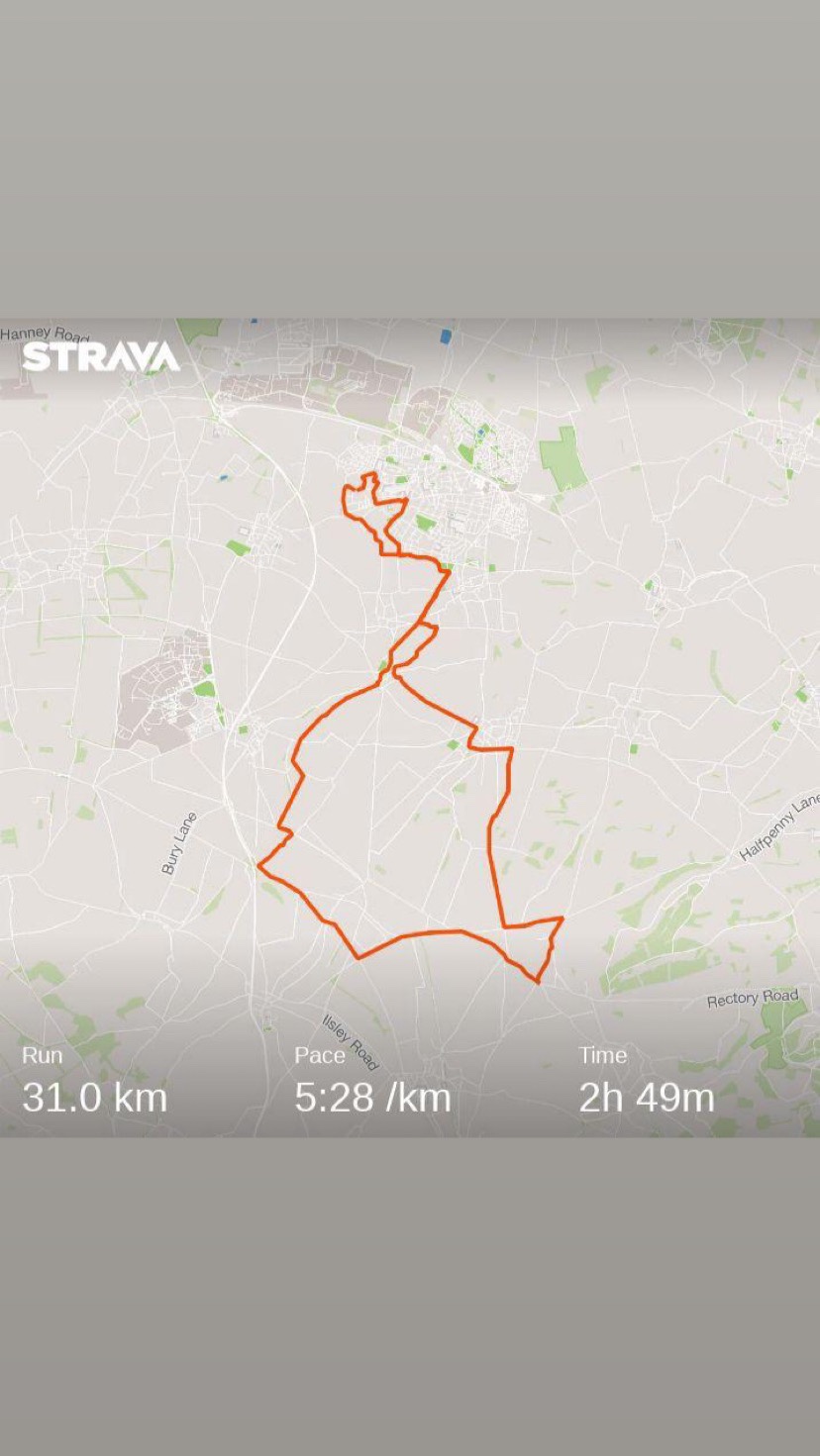
It was good but a faster pace than I plan for the Stones. Bit a bunch of mixed weather, rain, breezes, sun etc. Good deal of mud and puddles etc. It was good to get a run along the Ridgeway this close to Stones too as the terrain changes during the year and keeping in tune with the terrain is really helpful.
Found on route a new running buddy:
During the run I needed about 700mL water (I tend to run with tailwind in my water! Cliff blok’s are never far away (has a couple) and half a chia charge peanut butter flapjack. Felt good, hydrated and not struggling nutrition wise at the end. I would need to Jew this going as a minimum and probably throw a few savouries in too for the Stones. I also carry dextrose and salt tablets which I rarely use but will have with me on the Stones as I have found them helpful when struggling.
My only challenge is on longest runs I get some small blisters. I chose not to tape my feet this run but that was a mistake. Got a couple of blisters on the side of the ball of my foot and big toe. They are minor and mostly disappeared by 24 hours post race and normally taping avoids them better, so I’ll be going back to taping for all 20 mile runs or more!!
The final big one
Running for me is balanced with working and family life. I have made a run shaped pocket in my diary pre-work between 5:30 and 6:30 am Monday to Friday. At the weekends a similar space has been found on Saturdays and on Sundays I have forged a slot up to 10am regularly for a long run – giving me 3 hours comfortable run time. Much more than this is tricky. I could get up earlier but I’m pushing my body to achieve the start times I do anyway! So at time I have to work hard to find an opportunity for a longer spell. This is what I got months 30th June. Admittedly I would prefer it a week or two earlier but that’s the best I can do. So I managed to get a free day pretty much and have planned a 50km last push before the Stones. The plan involves a circular route from home and out via the Thames Path and back via the Ridgeway from Goring:

Some of the route will be new to me but I suspect it will feel familiar and will be fine. It’ll be a good measure of the terrain we can expect on the day, assuming we don’t get insane heat or monsoon in between the race and the 30th!
Kit Time
So running through final thoughts of what I take with me. I have the 10L Kalenji hydration bag from Decathlon. I’ll be taking the bladder and Tailwind powders to use in top ups – not always, some will be just water. I’ll carry chia charge flapjacks as I am really comfy eating these on runs and need the comfort of a familiar food. I’ll also take a small first aid kit, blister plaster, foil blanket, rain jacket and charger for my phone and headlamp (Petzl)
I will also take a t-shirt and change of socks.

I may take my GoPro and so have a few bits for that too.
I am hoping that family will meet me along the route and so will arm them with a top up of t-shirt and sock replacements. Probably more snacks and other emergency things such as swap of shoes, and generally enough spare kit for any circumstance!!
It’s all in the mind
Lastly is getting head-ready. I’m getting there but the natural nerves are already beginning to build. So let’s see how things progress over the next two weeks. I’ll be nervous and I’ll question my choice. That’s the way I work so I don’t doubt that. It’ll be good to feel I have that in check and under control, and that it’s not being obstructive to effective training and race preparations!
We will just have to see!
Looking forward to seeing everyone on the day 👍
Hampshire Hoppit Trail Marathon 2019


The Hampshire Hoppit is trail run through the North Hampshire hills. On offer to budding trail runners is a Marathon and Half Marathon distance. I decided that this would be the best option for my second marathon and my first ever trail marathon.
From the offset the organisation is great. Some good communications from the organisers and good active facebook, twitter and web platforms to inform and engage with participants.
Number and race pack is collected on the day, with final instructions sent out a few days earlier. I was getting a bit nervous about having missed something as the final PDF of instructions only came out 3 days before race day, but at least you know the details are going to be up to date! To be fair the organisers did communicate this date about a week prior too.
The marathon was set to start at 9am. I was taking the whole clan with me for support, but also as the in-laws live int eh village of St Mary Bourne my wife was making a visit whilst I was trotting around in the country, and then coming back to see the finish. Journey to the race was, as you can imagine with 4 kids, a struggle and I only got to the registration tent 15 minutes before the race start. Not my preferred level of organisation. Im a bit of a worrier (I generally manage to hide it, but I don’t like being late!!). So I was in a bit of a mild flap that I was going to miss the start. No need to worry. I was ready on time, but the organisers made it clear that the start would be held if anybody was still registering or getting ready, so that’s really great and immediately put my mind at rest!

So, number 266 was mine, bib fixed, vest on and thankfully sun out. Weather hadn’t been great in the run up (pardon the pun) to the race, but on race day it was simply spot on (maybe a tad too warm!), but I had the suncream and cap so all was good.
Going in to the race I was aware that this was a hilly course, and that there was ‘that’ hill at the start. I read on facebook a comment where somebody had asked ‘is the hill at the start runnable’ and the response was ‘it’s barely walkable’. OK! That really is a hill then! This was going to be an interesting challenge!!
Before the race my only marathon was Brighton in April this year (2019). I had completed it in 3 hrs 44 minutes. I had struggled on the final 6 miles and cramped at 25 miles. But I had a marathon time, and thought, given the hills, 4 hours on this one would be good. So the call to make the start line was made, I had 4 hrs in my mind and the family walked down the track a little to wave me off as the race started.
So race on, the course started in Kingsclere stables and then exited the stables/gallops area and off to the hills.
About 0.9Km in the first ‘barely walkable’ hill raised its head and there started the tail of the hills of the Hoppit.
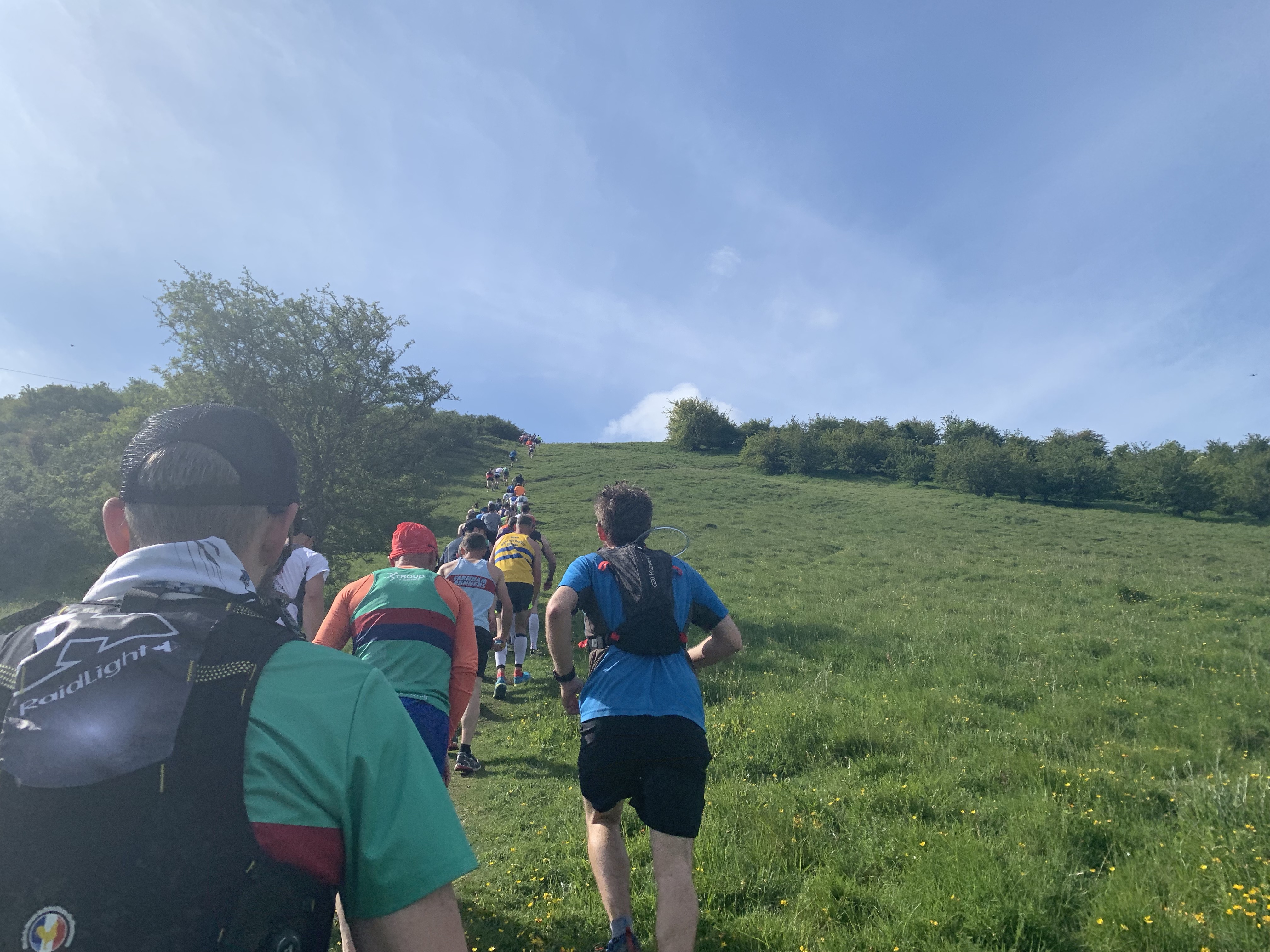
‘Runnable, it’s barely walkable!’
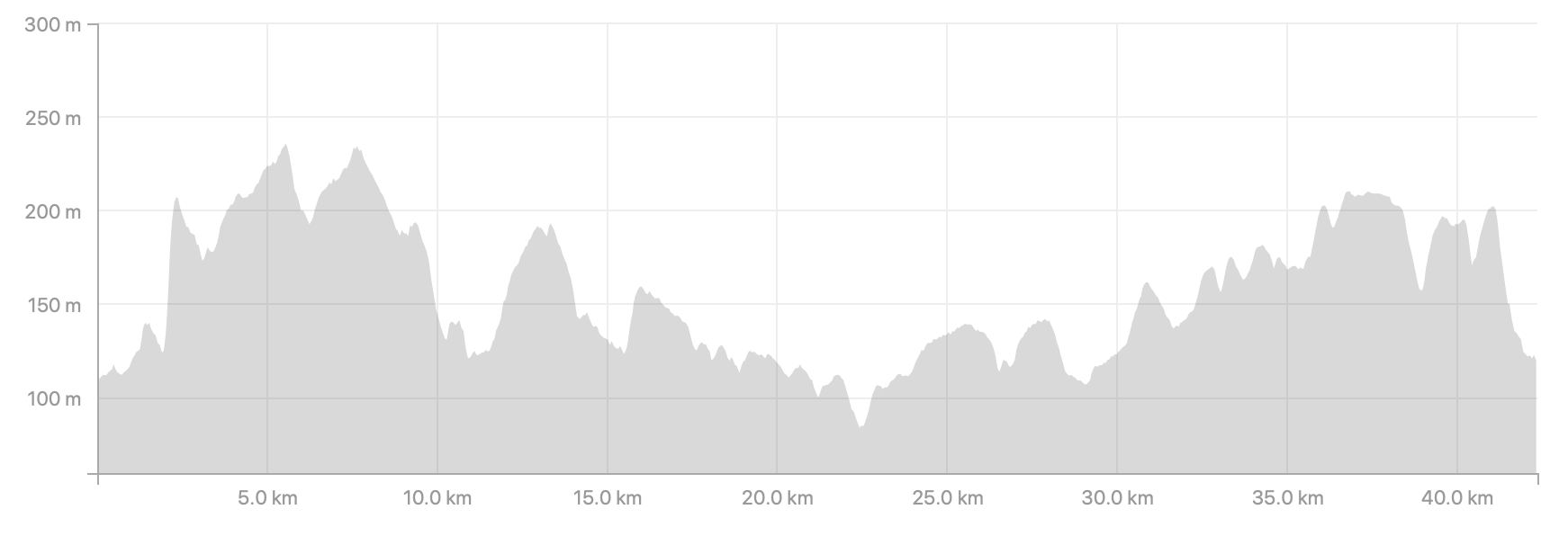

So the elevation plot will give you some idea of the hills that lie ahead of any participant of the marathon. I think it’s fair to say that there really isn’t any flat sections, none, not 1! it’s either go up or down!
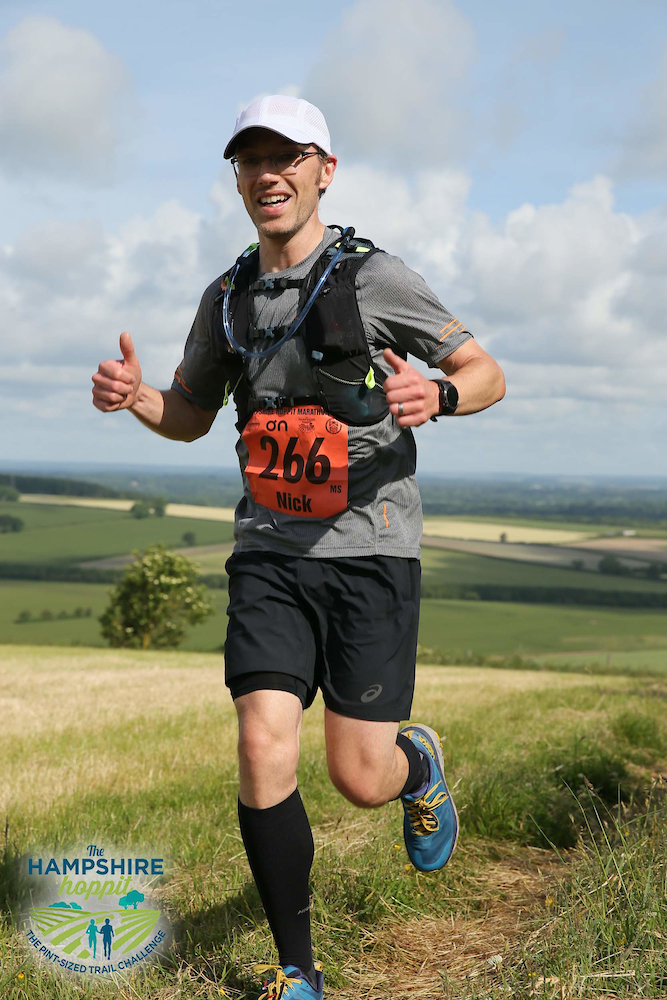
So I got to the top of the hill, even without the term running featuring, frankly a rope and climbing axe wouldn’t have been out of place!
Reaching the top was a relief, the pace picked up and I cracked on.
Not long after I hit aid station 1, and the ‘cup’ was the order of the day.
One of the excellent little features of the race was that the organisers decided to go cupless. I’ve run two races that have gone bottleless and seen varied success. Brighton Marathon had paper cups, they were fine once you learnt the pinch and pour technique. I also had a trail half in May that used plastic cups (not sure that’s exactly a real improvement on plastic bottles !!) and they were impossible., Pinch and pour resulted in pinch, split, splash! Anyway, the organisers of the HH decided to issue collapsable running cups to all for free. This in my mind was a genius idea. they were good little cups, worked well and branded as a memento. Well done guys, great decision.
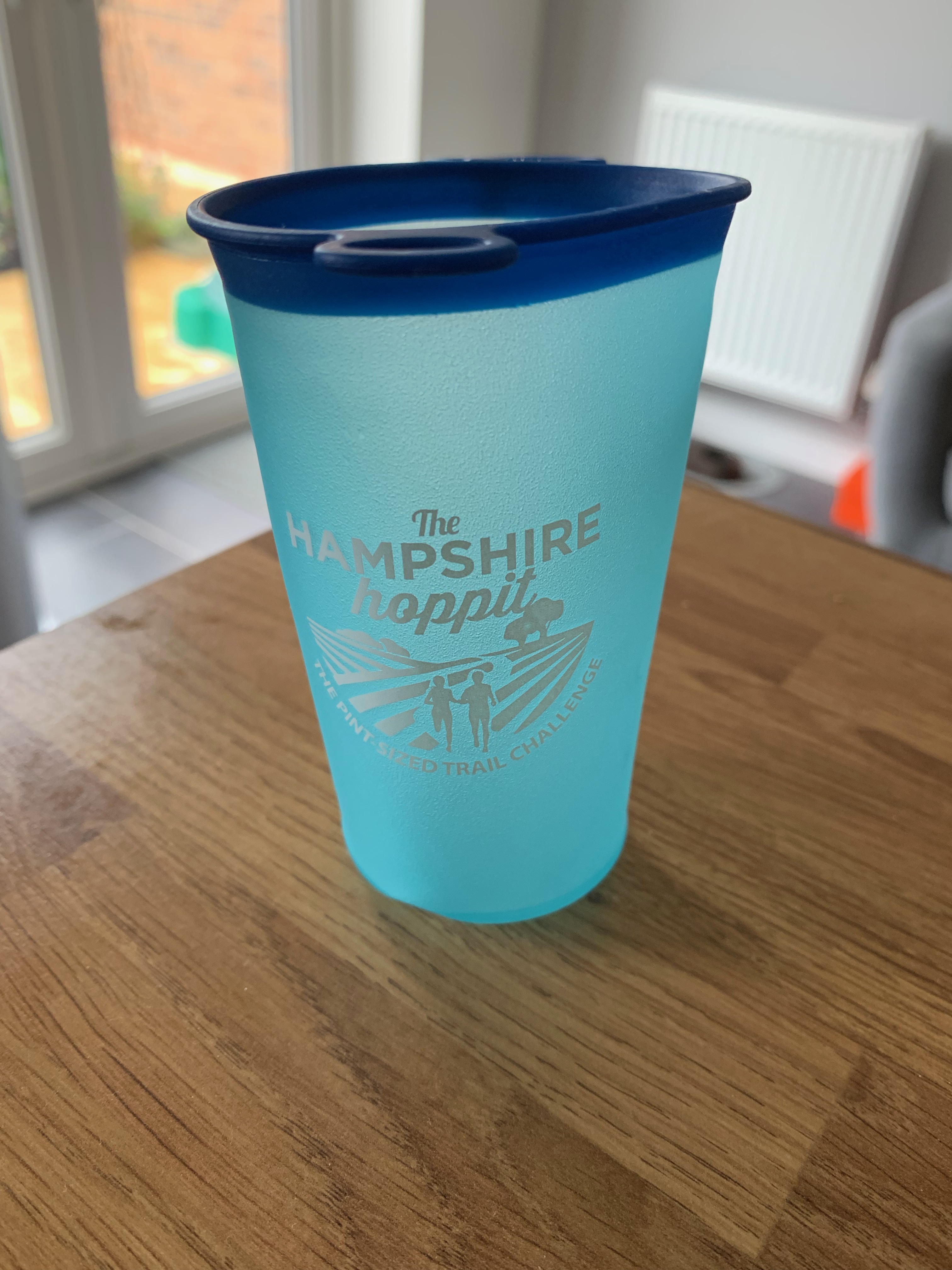
The race then continued with some great scenery and some great (honestly!) hills. The aid stations were frequent and run by some excellent volunteers so keen to help and keep you fuelled and hydrated.
As the race went on the hills were constant. To be fair the elevation profile makes it look worse than it was. A lot of the ‘gentle’ hills feel flat based on the fact that there is the occasional steep one that stands out!
The Half Marathon starts at 10am and for a period it meets with the Marathon route and at this point I got a bit confused. reason being in a Marathon (or any other race for that matter) I make sense of my run and pace based on the people around me. When the two races merged there were a lot of additional runners around all of a sudden and it was hard to keep a track of the ones that were in the Marathon around me. That said it was not a real issue, apart from my pace was that little bit quicker than a good few of the HM runners at this point so there was a little more doing to be done. All the other runners though were fantastically accommodating and moved aside without any problem, thank you !
As I reached 20 miles I got a stitch, my fault! I do follow the rule that you don’t try a new thing (kit or food/drink) on race day. Always try things in training first. For some reason I was tempted by Pepsi on the aid station so pulled out the collapsable cup, filled up and slugged away. This was a mistake (and possibly my only niggly complaint) the Pepsi wasn’t flat, so the bubbles surprised me and I’m pretty sure gave me a stitch a little while later. But that’s life, you learn. So I cracked on, at 20/21 miles though another modest hill arose in front of me, and the discomfort of the stitch just meant I was down to walking this one! Im always disappointed when this happens, but to be honest, there were worse hills still to come!!

Hill over, surely that’s the last. Erm Nope. I refer you to the elevation profile earlier. But you know what, it’s the hills that make this an amazing challenge and a fantastic race. The hills just go on until the last half mile pretty much. every turn when you think there surely cannot be another hill as the race is nearly over, they slip another in, just to keep you awake!
So the end arises. The finish arch appears in the distance and as you descend the final stretch (a descent that is pretty steep and isn’t as easy to run down as you would like!) the aches and pains disappear. I find a few more ounces of effort, push the pace as best I can and for one, finish the race with an actual smile on my face.

Thankfully my family had made it back from the visiting the inlays to see me finish which was great. I always get a real buzz from having family there to watch.
I had finished, I completed it in a little over 3Hr 49mins and was so happy. Only a few minutes outside the Brighton time, but given those hills that to me is a massive win!
So race over, but that’s not the end!
The Hampshire Hoppit isn’t called the Hoppit for fun. A significant benefit of this race is that as part of the reward for surviving you get a pint (marathon) or half-pint (half marathon) glass. And the real bonus is the free fill of Hoppit Ale from the Lodden Brewery near Reading. Now I might have just completed a marathon, but that is a might fine ale!!!!


So, Hampshire Hoppit, thank you for an amazing day. The race is a real challenge but such a stunningly stout race with amazing views and hills on hills that it was a delight to be able to take part. The volunteers were amazing and helped make the day spot on. The medal, glass, T-Shirt and general feel before and after was perfect, and you even organised for about the only sunny day in June so far!
I’ll be back without doubt.
And finally, we all know that a marathon is tiring and the last thing you need is a long walk to the car afterwards….

Hampshire Hoppit Marathon, 2019


Training Advice, Links and the like
Half Marathon Training 10 Week Plan
Advice and articles
- Building strength for hill running
- A running addict?
- Free Marathon training plans
- Core strength routines for runners
- Best running blogs according to Run Mummy Run
- Ultra Running with the Brain – The mental challenge of Ultra Running
- Cross Training
- Running documentaries
- London isn’t the only UK Marathon
- Things they don’t tell you about running an Ultra
- Ultra Marathon Recovery ideas
- Hill Training – the what, how and why
- Ultramarathon training – a guide to everything
- Summer running tips
- breathing Techniques
- Getting through my first 100Km Ultra
The 5-Minute Leg Circuit for Mountain-Running Strength
Use these exercises to improve climbing strength and downhill resilience
— Read on trailrunnermag.com/training/cross-training/the-5-minute-leg-circuit-for-mountain-running-strength.html
Having done the Hampshire Hoppit and thought that I’m going to need to step up my hill running game a bit, I’ve found this simple and short circuit session for hill climbing strength. Worth a shot I would say!!
Photo Gallery from Hampshire Hoppit Trail Marathon 2019


266 
266 
266 
266 14 000 
266 14 000 
266 000 
266 000 
266 000 
266 000 
266 
266 
266 
266 
266 
266 
266 
266 
266 
266 
266 
266 
266 
266 
266 
266 
266 
266 
266 
266 
266 
266 
266 
266
Race to the Stones 2019 – it’s the final countdown

Well it’s about a month out from RTTS 2019 and time to stop worrying about have I done enough and start worrying about everything else 😱😱😱😱
As the sound of the song from Europe “The Final Countdown” rings around my head I find myself thinking about the final phase and specifically I find myself thinking about the mental aspect of running 100Km in a day. Thats a big deal. Physically its a big deal, but mentally it’s an unknown quantity. What do I have to compare to the mental challenge of throwing myself around the Ridgeway National Trail for 100Km without a break for a good nights rest. How can I baseline that to anything, I’m not prepared for this.
I’m not prepared for this.
The thought of a first Ultra is somewhat daunting. I’m always keen to run a race and this is no different. I always want to do the best time I can in a race and this too is no different. Of course I’m not blind to the fact that this is 100Km and hilly and off road so I know I won’t run it all, but I still hope to achieve the best outcome realistic.
So what’s left to do?
The miles are mostly done. There’s little more I can do now that won’t just make me exhausted for the race itself. I’ve one serious long run (50km) planned a couple of weeks out from the race and otherwise it’s just some routine easy and mixed effort runs in the weeks and 10-20 miles long runs at the weekends. Two week taper? Should be enough? We will see!!
Year to date I have pushed out 1246 Km and expect another 200+ Km before the race itself.

The kit is mostly sorted. I’ve listed my kit below:
- Kalenji 10L backpack
- Tailwind in my water bladder and spare to renew
- change of clothes including hat and socks
- first aid kit with blister kit
- foil blanket
- head torch and spare batteries
- mobile phone charger and cable
- running watch (Garmin Fenix 5)
- Route on phone and loaded to watch
- Energy gels (I like SIS so take my own)
- Cliff Blocs (ditto)
- Chia Charge Flapjacks – simply nothing compares to them for running fuel
- Sun cream for before the start P20
- Vaseline to avoid the sore parts 😉
- Shorts
- Running T-Shirt/Vest
- Compression socks
- Shoes – Not sure yet but Hoka Clifton 5 or Hoka Challenger 5 are the two candidates

Meet up with support/family on route planned for one maybe two points. We live near the Ridgeway so know good points to meet.
Transport: Well I have an amazing wife. Enough said!
The Head: Well to be honest this is where it gets a little flaky.
The real challenge
The real challenge of trying to do the best run I can at RTTS will be in my head. It’ll be the longest time I will have been out running for. It will be the longest distance I will have ever run. It will be the biggest challenge I have faced since I bought a pair of running shoes in a New Balance outlet store in Swindon, UK and though – “well how hard can it really be?”
To be honest, I’ve become obsessed with running and the thought of endurance running. RTTS is my first chance to see if that is a complete pipe dream or whether its something I can genuinely conquer. I feel I can and I want to, but really, an ultra runner – I’m 42 with 4 kids a demanding job and a working wife. This is a bit of a silly idea really.
Sometimes a silly idea turns into an ambition though, and an ambition into something that you just need to do, to prove to yourself, to meet that feeling of challenge and to stare at it face on. I don’t fear fear.
I’ve found myself now watching a lot of ultra runner films, especially The Ginger Runner films, but also films about some of the real serious ultra running events in the US, Western States 100 for example. And if I’m honest, they have really helped. These men and women taking on these monumental challenges are no different from me really, or from you or anybody else. The thing that has enabled them to do what they do is the drive to prove to themselves what they can achieve, that drive to prove the doubt in their mind is wrong, that the voices that make them think “I can’t” are wrong and in fact they can. These films are often emotional for the runners and the teams around them, but they can be touching to watch. Watching Gary Robbins tackle the Barkley Marathons is an amazing film. At the end of the day ultra running to me is not about beating other people, it’s about beating that version of you that doesn’t think you should even line up at the start line, that thinks you shouldn’t have bothered putting those trainers on, or pinning a number to your chest. That’s my race. And when you watch these films, that’s really what most of the runners are competing against. They are competing with each other, but all against different challenges.
So does this mean I am mentally in tune with the 100Km in one day challenge I have lined up. Well no. not really. But does it feel that I am in a position to meet the challenge head on – you absolutely bet I am.
I know in my first Ultra it might be too much, I might not get to the end. It really is a big challenge to try and run as much of it as possible. But to be honest, when I put that number on my shirt and turn to face the start arch, well I’ve already won at that point, and the 100Km ahead of me is my victory lap.

But to be honest, when I put that number on my shirt and turn to face the start arch, well I’ve already won at that point, and the 100Km ahead of me is my victory lap.
Some of the films I find inspiring:
Variety is the spice of life

Running is running, right? Well yes and also no. Moving by foot faster than a jog is a run, nobody can deny, but there are many types of run that you can do, mixing up speed and duration and repetition. This variety is one of the best ways to keep things interesting, as well as a fine way to improve your running performance, pace and abilities.
Below are a list of run types. The best plan, IMHO, is to mix a few of these runs into your running but balanced with easy simple paced runs.
I like to run to heart rate zones. This might not be your cup of tea, and that’s fine. But to explain, I will refer to 5 zones numbered 1 (easiest effort) to 5 (hardest effort).
If you don’t use Heart Rate Zones, then in brief Zones 1 and 2 would be the kind of pace that makes you feel able to run forever, hold a good conversation and generally feel like you are well within yourself. Zone 3 begins to make you move, you can still have a decent chat whilst running, but you now feel like you are putting some good effort in. Zone 4 is making you feel it, you might find it hard to say much when running at this pace and you feel that the effort is strong, but that you have a little more in your locker. Zone 5 is as much as you have. Talking is unlikely and you probably doubt you can sustain it for any hugely significant time.
Easy Runs
Easy runs are meant to be just that. they should be in Zones 1 or 2. Steady pace, comfortable. Great for recovery after long or high intensity runs.
Intervals or Fartleks
These start and end with a warmup and cool down at easy pace (Zone 1). The intervals themselves are at the highest effort you can do (Zone 5) for a short period. Maybe 30s, 60s, 90s etc as your level can achieve. you repeat these a number of times (4, 6 or 8 maybe). in between each high effort interval, rest at easy pace for maybe 2 minutes.
As your running develops, increase the repetitions, or interval durations.
Cruise Intervals
Basic premise the same as for normal intervals, however you hit middle effort (Zone 3) rather than Zone 5, and sustain this for longer, maybe 5 minutes. Repeat 3, 4, 5 times etc. Rest for 2 minutes between intervals.
As your running develops, increase the repetitions, or interval durations.
Mixed Intervals
This is a block of intervals covering medium and higher effort speeds. Using Heart Rate Zones as an example, a mixed interval session would look something like:
- warm up
- Zone 5 – 60s
- rest 2 min Zone 1
- Zone 4 – 5 min
- rest 2 min Zone 1
- Zone 3 – 10 min
- rest 2 min Zone 1
- Zone 4 – 5 min
- rest 2 min Zone 1
- Zone 5 – 60s
- cool down
Tempo Run
This uses the same effort level as the Cruise interval (Zone 3/Medium effort) but sustains this for a longer period, i.e. 30 minutes. include a warmup and cool down at low effort.
Increase the temp duration as your running develops.
Progression Run
In this run you look to break the run into a number of sections, maybe 3, 4 or 5 for example. You run each section at a high pace than the previous session.. this is good for building an understanding of what your pace feels like and enabling you to ‘feel’ your pace.
As your running develops increase the number of sections and look to hit faster section paces. Also look to increase the duration of the section.
Hill repeats
Does what it says on the tin! Find a hill and run up and down it. Do so aiming for low effort, but the act of hill running will usually mean the effort feels harder than your pace suggests – this is normal so don’t worry.
As your running develops increase the number of repeats.
Long Slow Run
Many runs in routine running will be short 20, 30, 40 minutes. But if you want to achieve longer runs such as Half marathons, Marathons or ultras (eek) then time on your feet is key. This can be best achieved by finding time, maybe each week, to go for a much longer run, maybe 60-90 minutes. These don’t aim to be fast. They are used to just get your body running for a long time so longer dsistance events are more achievable.
As your running develops you can increase the duration of these runs, consider more challenging terrain (include hills and trails etc) or look to include faster sections (a bit like chucking a few intervals at higher pace into a long run).
Putting it all together
Thats the challenge. how do you take all of this and make the best use of it. Thats does to you as an individual. If time is no question/obstacle, then run as much as you can, making 1 in 3 (-ish) runs a higher effort option and the rest lower/easy effort. Include or add a Long Slow Run too. But you need to pick the frequency and durations to fit with your other commitments and lifestyle etc.
Needless to say any run is better than no run so just running is a great start.
 Ridgeway Runner