Brighton Marathon Route Info

Route information from the 2019 Brighton Marathon

Start at the park. There are a couple of hilly road sections around the park but generally not long so steepish but OK. Once you hit the seafront past the pavilion you head east. this is a steady gradual hill towards the windmill in the distance.

The turn is great however the downhill doesn’t feel as long or rewarding as the uphill!!

Back through the centre of the seafront, inches from the finish line!!! and our West. Following a detour away from the seafront and back again you head out towards the Power Station. This is a narrower less supported section. Its hard going for less experienced marathon runners as the crowds are huge until this point. After heading back east you rejoin the seafront and the crowds. Past the i360, then the pier and then the finish line is in site.

A really excellent marathon, great support and plenty of water stations.

Highly recommended for all!

Route of 2019 Brighton Marathon
Elevation plot of 2019 Brighton Marathon

Please note that the blog doesn’t allow .gpx files so they are all finished .gpx.xls. just remove the .xls and all is fine!!

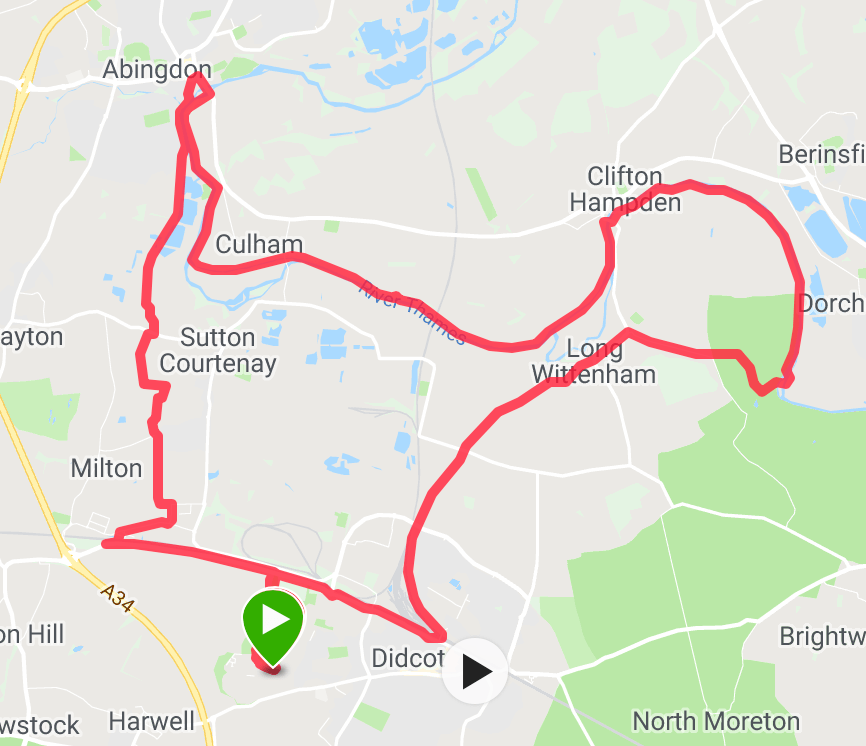
22 Mile route Through Didcot-Thames Path-Abingdon-Didcot

Mostly flat along the Thames Path. Some of the Thames path is a bit cut up and often is damp. Some fields of cows and sheep to navigate – especially nearer the Dorchester on Thames section. Link between Wittenham and the Thames path is via a couple of back gardens with Footpaths through them, and one stretch of footpath near a farm that is often overgrown – warning stinging nettles waist high!!!

Route from Abingdon back to Didcot much more path and gravel than mud track, except the final bit before Milton Park.

Route Map
Elevation Plot

GPX File (please edit off the .xls file extension)

Please note that the blog doesn’t allow .gpx files so they are all finished .gpx.xls. just remove the .xls and all is fine!!

One of our Mojo’s is missing

I’ve been running for near on two years now and that’s a mere scratch on the surface of some of my fellow runners who can count dozens of years on their running back catalogue. During that short period of time I’ve engaged with various social media groups and have seen a lot of people achieving great things but also seen a lot of people struggle to maintain their efforts with a loss of motivation.

I thought I would put down my thoughts on this, what keeps me going, and share some of the feedback I have collected from willing participants through various Facebook groups.


Mojo, motivation, drive, encouragement – the same beast with a different name


So we all need it, some of us more than others, and some of us don’t realise it, but something gets us out the door each time we run.  Something generates that need to train or workout.  However, for some, this can be buried deep sometimes, hiding behind many other things (fear, self-consciousness, worry, anxiety … ) and if you can’t uncover it that can be enough to stop you from opening that door and making the first step.  Many of us have experienced this in some form, sometimes every run starts with a mental battle with ourselves.  Sometimes we win, sometimes we don’t.  And when we don’t there can sometimes be a cumulative effect, resulting in that motivation getting buried deeper and deeper.  Sometimes reaching a seemingly irretrievable depth.

Loss of motivation can be enough to put an end to a running hobby.  It can end all the good work and potential that running has and can bring. It can sometimes be a hurdle that simply appears to big to break down.


Below I’ve put a few thoughts and ideas about what a motivator might be, what can help overcome that feeling of loss of encouragement.


Why did you start

Sometimes it’s all too easy to forget the reason that got you out in the first place.  We all have a reason that meant we once stepped out the door and tried to run.  In many cases there is a fitness or health reason.  Just remembering this can sometimes give you another nudge to get out the door.  It is great to use running to achieve a goal, but sometimes this can be forgotten, and the benefits lost reversed overtime, slipping back to where you were before you started.  Recalling that initial trigger point and the reasons you felt you needed to go and run, can bring it all back and be the motivation you need to go again.


Fitness and Weight Loss

Many of us run for fitness and weight loss.  Either through a fear of being unfit or gaining weight, or as a driver to improve our fitness or lose excess weight.  Running is a great mechanism for this, but often needs balance with diet.  It really can build fitness and help with weight. Sometimes it can be quick and people will see a change pretty quickly and sometimes this isn’t the case.  It can be frustrating to try and lose weight through running and not see any great progress.  Keeping motivation in this case is tricky.  But it’s fair to say that giving up the running won’t result in the desired benefit.  Perseverance will win out.  Keep at it and consider adjusting diet to help reach the desired result!

belly-black-and-white-black-and-white-42069

Head Space

A lot of people that gave me feedback for this blog said that running gives them ‘me time’.  There are many reasons why this is useful.  Whether it’s busy home life or work life, struggling to understand the complexities of modern life, politics or the general madness that might be going on around you, running often creates a little bubble in which you are able to operate outside these normal pressures.  I for one find the destressing benefit of a run (be it 5Km or 26 miles!) is immeasurable and I just don’t find another way of getting this space to myself.

adult-blur-cap-810775.jpg

History

If you are lucky enough to have access to areas of historical importance getting out and running through them can often get you mind thinking.  If only these paths could speak!  I often run on the Ridgeway National Trail route in Oxfordshire.  It’s one of the oldest paths in the country.  The thought that I’m walking/running on a path that has seenthousands, maybe millions of people over its lifetime is really cool.  What were they doing, where were they going.  They could have been Romans, Soldiers, famers etc.  It’s great to consider that you are building part of the history of such a route.


A contributor said:

We’ve walked this land for thousands upon thousands of years and discovering ancient paths (or ones that give all the hints of being ancient) is just so special. There’s always that drive to look round the next corner or to check out that patch of old yew trees up ahead. I love reading about the history of the land where I run (and looking at the old maps) and already, I’ve discovered so much!

activity-adventure-boy-551857.jpg

Achievement

All runners achieve great things.  Sometimes you don’t realise, or can’t see it, but just running is a great achievement. The fact that you might struggle with motivation might suggest you don’t see this.  Look around you.  There’s oh so many people that didn’t manage that first run, that haven’t even reached the point of realising a run is a good idea.  You’ve managed that – that’s a great achievement – well done!

Achievements come in many forms.  Running itself, that first 1Km without walking, a 5Km run, 10Km run, a PB etc the list is endless.  All of these can be motivators.

Entering an organised event is an achievement as can be completing your first event.


The one big thing to remember is that runners come in all shapes, forms and abilities.  You are you and not somebody else.  Your achievements are yours specifically and so just because somebody else runs 5Km or 10Km without breaking a sweat and for you it takes every ounce of effort doesn’t matter.  Compare yourself with your past only and aim for your future only, don’t compare yourself to other runners!


Time with friends

Often runners are either lone runners or group/community runners.   Whatever works for you, but sometimes running with others is a good reason to run, and can be a motivator to keep it up.  Running needn’t be a chore.  It can be a social activity with others.  Keeping fit whilst spending time with friends sounds like an ideal way to spend your time. Sometimes you might feel that running with others might be embarrassing or show you up as a poor runner.  But scroll back, its friends, you are all in it together and if they are friends then everyone will be supportive!  Go on you might just realise how great it can be!

backlit-bright-dawn-697243.jpg

Nature

A lot of us live in cities and major urban areas.  Surrounded by concreate, buildings, people and cars.  If you can get access to the countryside you can often find a new world out there to explore.  And with countryside comes nature.  A lot of people find swapping the city for the fields is enough of a reason to get out and run.  Swapping the sound of cars for the sounds of larks, thrushes and kites brings motivation. The smell of fields full of crops and the sight of deer and other wildlife gives a run a real mechanism to drive you forward.

body-of-water-dark-deer-1636018

Experiencing new destinations

For some, running can become boring.  Tedious, running the same streets and routes, seeing the same sites and feeling that you are just going around and round (sometimes literally!).  Running is one of the best ways to explore.  There are many tools online and apps for your phone to help you explore when you run.  You can plan a route that’s different to normal, follow other people’s running through Strava or Garmin Connect etc.  Or you can drive thirty minutes away from home and run somewhere totally different.  Almost everywhere there is a gem of a running destination within your reach that you have never seen.  Adding variety of location and sites in your running gives you a great excuse to put the trainers on and go out and about.

adventure-camera-coffee-1051075.jpg

Structured training plans

As already suggested, running can become routine and repetitive.  For many running involves going out the door, running for an amount of time, or along a particular route, and then getting to your destination. Its understandable that doing this every time could seem monotonous and dreary after a while.  So why not make your runs have a different purpose. These needn’t be complicated, but again, a bit of variety can maintain interest.


I always look to follow a training plan that is structured.  I run a good number of events and so I am often training for an event and find myself almost always following a training plan.


What can you do to create variety?

It can be quite easy to be honest.  There are a whole load of different run types you can adopt.  Im planning a blog outlining a whole load of run types with some detailed explanation but in general these are some good ideas:


  • Run some of your runs easy – not pushing too hard, feeling that you could try harder if you wanted to.
  • Run some of your runs with a gentle warm up, a period of harder effort and then an easy cool down.
  • Run intervals or fartleks – short periods of real hard effort interspersed with slow paced /walking recovery (i.e. 30seconds hard effort and 2 mins recovery, repeat this 3, 4, 5 times as you see fit)
  • Keep runs mostly short in time (and distance) but throw a longer run in once a week or fortnight as best you can (maybe 3 times the normal length of run)
  • Put hill running in. maybe a run every now again includes some hill ascents 0 doesn’t need to be Everest like but just an incline – don’t worry about pace, just chieve the climb.


This sort of variety benefits you in two ways.  It adds variety so avoids the feeling of runs becoming too boring!  These types of runs can also help you become a stronger more accomplished runner, often helping you achieve better endurance and speed – if that’s something you want to look for!


The support of the wider community

One final point I will add is that the running community is huge.  Facebook in particular has a large number of groups for runners.  Some are targeting trail runners, or particular running clubs, or older runners etc.  sometimes these, like any Facebook group can be a bit rubbish.  But in my experience, many are incredibly supportive.  They have a huge collection of runners all going through the same journey, all trying to achieve their goals and many struggling to maintain the motivation to make it happen.


You are not alone, we all struggle at times and all find it hard to make some of our runs happen.  But keep the faith, look for ways to recover that drive and remember that you are achieving every time you step out the door to run.

Hokae Clifton 5 and ATR Challenger 5 review 2

The story so far…

So having found my size 9 runners were now too small for my growing 42 year old feet ?!? I found my way to a brace of new pairs of shoes the Hoka OneOne Clifton 5 for road running and the Hoka OneOne ATR Challenger 5 for my trail and mixed surface running.

My earlier review on how I got on is here.

Where are we at…

So as of May 22 the shoes have both broken the 100km mark and I thought that was a good time to give a follow up. Often shoe reviews are given after an initial view and test. I’ve now put on over 200km in these two pairs so feel that I can give a pretty reasonable update of life in the Hokaverse!

(Pictures as of May 21)

Clifton 5 – 15 runs 116km

Challenger 5 – 5 runs (including one Half Marathon comp) 106km

Review and Opinion…

Clifton 5

So the Clifton is a neutral, road shoe with a modest heel to toe drop. It’s a well cushioned shoe too.

So far I’ve found the shoe comfortable and responsive. I’m used to Brook’s shoes and the Clifton feels lighter when in use.

My running has been consistent and at the higher end of my usual pace in these shoes which is encouraging too.

The change in shoe has had no negative impact on the old body with no issues with knees, ankles or hips. I’ve had a couple of knee injuries since taking up running and so this is particularly good news.

Durability wise, well they look pretty much as new. The sole is wearing very well and the upper is perfect – no sign of any poor manufacturing or weaknesses that some reviews have highlighted.

In comparison to the Brooks I would say they do come up smaller and in particular narrower across the toes/forefoot. So if you tend to trend slightly wider on shoes these might take a lot of wearing in or might just now work.

ATR Challenger 5

Much like the Clifton to be honest. Wearing well, the fit and feel is similar to the Clifton with a ‘narrower-than-Brooks’ feel across the toes/forefoot. Responsive and cushioned and even on some rougher trails a stable and capable shoe.

The shortcomings of the shoe is simply that it has a niche in the types of use it’s designed for and it doesn’t like pushing it to the trail extreme. It doesn’t like a lot of mud and struggles to clear mud from the tread. One run I took resulted in me becoming about an inch taller due to the build up.

BUT they are hybrid shoes for road and light trail and they carry this of very effectively. Of mud is your thing then the Hoka OneOne Speedgoat is you weapon of choice. The Challenger simply isn’t built for it.

Summary…

In summary I’ve been really pleased with these shoes. The are comfortable, responsive and hard wearing so far. They are well priced too if you shop around. For me the cushion and neutral fit is perfect for my needs but of course we are all different so you need to give these a try and consider how they work for you if you want to give them a go.

I’m going to carry on thrashing around the streets and trails of South Oxfordshire in these and also put the Challengers to test on a few off-road races, including Race to the Stones in a few weeks (100Km). That will help select the men from the boys!!

BTW, this is all my opinion and in no way do I have any connection with Hoka or any other shoe manufacturer or provider. Everyone is unique and shoes often feel and fit differently between individuals. I hope you find this interesting and useful but please ensure you test any shoes you plan to use for running and make your own informed decision – 🤔

Nick


The Art of Running Slowly

The story so far

Having been running now since June/July 2017 I’ve really got to the point of enjoying my running.  Towards the end of 2018 I was going out running regularly, probably 4/5 times a week.  3 times during the week and trying to put in a long run on a weekend day.  This was invariably a Sunday.  It’s what you do as a runner isn’t it?  Short runs and a long run on a weekend!  So I was doing what I was meant to.  The thing was that although I might have been running with a ‘program’ I wasn’t quite sure what the program was telling me to do.  It would say go and run an ‘easy’ run or go and run a ‘tempo’ run, and do it for about 30 minutes.  great.  I assume ‘tempo’ runs are faster than ‘easy’ runs, but by how much.  I read a few websites and saw reference to running to a percentage of maximum effort.  Gee thanks, that helps.  it might sound straight forward but I really don’t think to the untrained, and aspiring runner, that this is at all easy to judge.  Like, what is the difference between 70 and 80% effort meant to feel like!  What I tended to do was go out running and almost certainly end up putting in runs of fairly similar efforts, all probably harder than they should be.  I remember most runs I would feel like I had out myself through it.  I would come back knackered from a 45minute 10K or a 60 minute 13Km run.  all runs ended up feeling as much effort at the end as each other.

To be honest, I kind of assumed that the only way to get better at running was to try hard every single time you go out.  Leave everything out there, take no prisoners, if you aren’t hurting then you aren’t trying!

I read an article in the RunnersWorld mag that mentioned about aerobic and anaerobic efforts.  It sort of made a bit of sense…

Making the change

Around the same time as reading the article I had been lucky enough to treat myself to a new toy.  The most amazing of watches (my opinion – other watchers might be just as good or better, but probably not 😉 ), a Garmin Fenix 5.  This watch could do everything, record and provide feedback on data I didn’t know I needed or wanted.  Not to mention data I simply had no idea how to understand!  The watch though would give me information about aerobic and anaerobic effort.  Ooh, I’ve read something about that …

So being armed with this new information – that I had limited understanding about, I started to make comment about it online in my training posts.  It seemed that I should be looking to improve my aerobic training impact.  I think that’s what I wanted to do anyway (I told you I barely understood!).

I started to get some really useful comments back and feedback, with some being very positive about the training, but I also got a few comments, suggesting that this was something people started to take note of once they started 80/20 running (shrugs shoulders and points palms up to sky).  Whatever that is.

Now I’ll be honest.  I am a quick adopter of new ideas, and often as quick to change my mind and give them up.  god knows how I managed to keep running towards 2 years now!!

So, step 1:

I googled 80/20 running and got a whole host of websites and pages.  I also found the facebook group 80/20 running.  Now there are lots of advocates of the concept (under various names and descriptions).  But the general concept is to put in low effort in the majority (around 80%) of your running, and only put significant effort into the remaining training (20%).  Doing that will make you a better runner.

So, let me put this straight in my mind, the key to being a better runner; to being a faster, more competent runner; capable of endurance and short runs, is to run slowly !?!  I must admit I just didn’t get that.

step 2:

I joined the 80/20 running facebook page:

80/20 running – Facebook group

step 3:

I bought a book which seemed to be popular amongst facebook and web page bloggers:

step 4:

and I found the associated website:

Home

the website has great information accompanying the book, especially training plans etc.

I got the book out, a cup of tea and started to read.  I got another cup of tea, some digestives and a bourbon and kept on going.

beverage-books-caffeine-904616


What I changed and what happened

I decided that the idea, once explained made a bit more sense.  Its just about building condition and capability within your body.  Doing it slowly so your body can make small steps towards a more efficient machine.  being more efficient then means it can do more with less.  Put in another way, but letting your body build up slowly it gets the opportunity to slowly grow and build and become better at what you are trying to get it to do.  It then becomes better at it, allowing you to achieve more with a consistent level of effort.

Now the obvious point is that this isn’t an overnight thing.  The bit that is tricky to get your head around is that you could go out and run a 10Km 5 times and push hard every time, getting a PB time after time.  the problem is that your body finds it harder to learn when you are pushing it to it’s limits.  This apparent improvement in many will be limited.  your body will soon reach a point of not being able to get any better/faster.  By taking a step back and reverting to this 80/20 concept you will make most runs slower than you could, but over time your body becomes better conditioned and more accustomed to the efforts.  It eventually starts to be easier to achieve a consistent result, or on the flip side, you can achieve more with a consistent effort.  Keeping this theory means you should find your body is likely to achieve more eventually, and you are less likely to strain, stress or injure yourself on the ay there as you won’t be hammering yourself every time you go out.

Methods of measuring effort

This varies and a number of options are out there.  My preference is heart rate.  Its a good indicator of how much effort you are putting in.  There are various methods to set what are called heart rate zones which then map to ‘effort’ zones.

You can use a variety of scales but my preference, and one that fits nicely with Garmin kit is to use 5 zones.

– Zone 1: Warm Up – 0-60% max heart rate

– Zone 2: Easy – 60-70% max heart rate

– Zone 3: Aerobic – 70-80% max heart rate

– Zone 4: Threshold – 80-90% max heart rate

– Zone 5: Maximum – 90-100% max heart rate

beautiful-hands-heart-5390

To calculate your maximum heart rate you can use various tests, or some sports watches will do it for you, but a good guid is 220 – your age.  Its an estimate and not always perfect but a good start.

If you can, there are tests you can run from various apps/fitness devices that work out your heart rate zones for you using a physical test and reading your heart rate etc.  But the estimate works well enough!

Variety is the spice of running

The additional feature of using the 80/20 book above is that it has some great structured training plans for various distances and levels of runner.

As I mentioned earlier, my runs used to be mixed with easy or tempo or whatever, but I never knew how to measure if I was doing just that.  By using heart rate I can use the heart rate zones to measure when I am working easy (Zone 1 or 2), moderate (Zone 3) and high effort (Zone 4 and 5).

Indeed, the training plans available within the 80/20 book and online set workouts using the hear rate zone as a measure workout parameter.  i.e run for 5 minutes zone 1, then 5 minutes zone 2, then 20 minutes zone 3 …

This basically means you can build a whole set of various runs, workouts and challenges around various heart rate zone patterns and durations.  mixing long slow runs with short high effort runs, with recovery and warm up and cool downs.

I instantly found this helpful.  I like a bit of form to what I do so I can measure if I am doing things right.  The theory behind 80/20 running made sense to me , and the training plans were built to fulfil the theory – that sounded perfect to me.  This I could follow, this I could work to.

I plan to put together a list of different run types, some explanations and descriptions and ideas as to when to use etc in a further post on the page so check back later or follow to get notified of further updates 😁

The results

Well I’m still doing it so results are ongoing, but so far so good.  There are a few things I have found about running through this approach.

  • I always have a purpose to my run reflected in the effort I run at, this makes all runs seem worthwhile and valuable and provides motivation to go out and do them
  • I have really enjoyed the high effort runs (short intervals etc) as I have a real framework to run to, I have found my sprint times really improve with 90second intervals now achievable at around 3min 20sec per Km, something I never anticipated possible
  • The overall program structure has motivated me to run more, 2019 has been by far the best mileage year so far (for the equivalent amount of the year that is) with weekly distances covered often well over 50Km
  • Running this way when there is a community of people out there doing the same has provided more motivation and feeling of support
  • I have found it helps support injury recovery.  Having injured my knee in Feb, I took a few days off and then used the principled of 80.20 running when coming back to it.  It was greatly effective and when I got back on the road I had a 3 week running streak of going out every day and quickly got back to over 50Km per week, being able to run the Big Half in March and Brighton Marathon in April without problems from the injury


So overall I’m still on the journey of 80/20 running and that journey looks to continue well into the distance, probably going forever.  In the early days I had to put my self perceived idea of success to one side and trust the approach was going to work.

I think this works, Im really pleased with how things have progressed and I feel I have reason to run, reason to follow the plan and am enjoying what I do.

Good luck in your running journeys!!!

Nick

Hoka shoe review

So I recently took to trying the Hoka OneOne Clifton and ATR Challenger 5 shoes. Reason being running has caused my feet to go up a size. 18 months in size 9 shoes and now need a 9.5/10!

So Clifton 5. Took a size 10 rather than 9.5. They are a comfy shoe and at the size up have a roomy toebox. Plenty of room for the little pinkies. They are a neutral cushioned shoe which is what I prefer to run in. I found them not quite as cushioned as Brooks Ghost or Glycerin my previous shoes but the level of cushion is good. They are a lower profile and have a more curved sole than the Brooks too.

They’ve been out with me now for a few 7-10km runs and a couple of treadmill sessions and feel great. Running in then seems easy and to be honest times have been very food – though how much influence the shoe has …

I’ll be sticking with these as my shoe of choice!

The challenger ATR also went for a size 10. Again good cushioning and neutral. Decent sole which looks durable but it’s not going to work on really wet trails – lots of mud I expect would cause an issue. But I mostly run gravel, compacted footpath etc so great for that. They are also designed as a hybrid shoe so good for road too – they won’t be worn out quickly or destroyed by road running. That’s great for me as many runs are a mixed surface – especially my long runs.

Both shoes are less cushioned around the heel which I thought I might not like and might be a problem but no worries there. Lower profile of heel to toe drop than the Brooks predecessors but again no problem me encountered.

Durability – well so far so good but hardly tested them to destruction so I guess we will wait and see but I’ve been impressed.